Quick Navigation
I’ve walked over countless rounds of golf in my life. My knees know it. My back definitely knows it.
Three years ago, I gave in and bought my first electric push cart. Having a motorized push cart changed everything. I went from being exhausted on the back nine to feeling fresh enough to actually focus on my game. My scoring average seemed to improve a bit—though that could just be the ebbs and flows of my continual improving and getting worse.
Since then, I’ve tested 14 different motorized push carts across courses in Virginia, North Carolina, and Florida. The Federal Club in Richmond. Raspberry Falls in Leesburg. That one course in Asheville where the 7th hole feels like climbing Everest. I’ve pushed these carts through morning dew, afternoon heat, and one memorable round in a thunderstorm that I don’t recommend repeating.
Here’s what I’ve learned: not all electric golf carts are created equal, and the most expensive option isn’t always the best fit for your game.
Our Top Picks for Electric Push Golf Carts
| ELECTRIC CART | OUR EVALUATION | OUR TAKE | CHECK PRICES |
|---|---|---|---|
 |
Best Overall
|
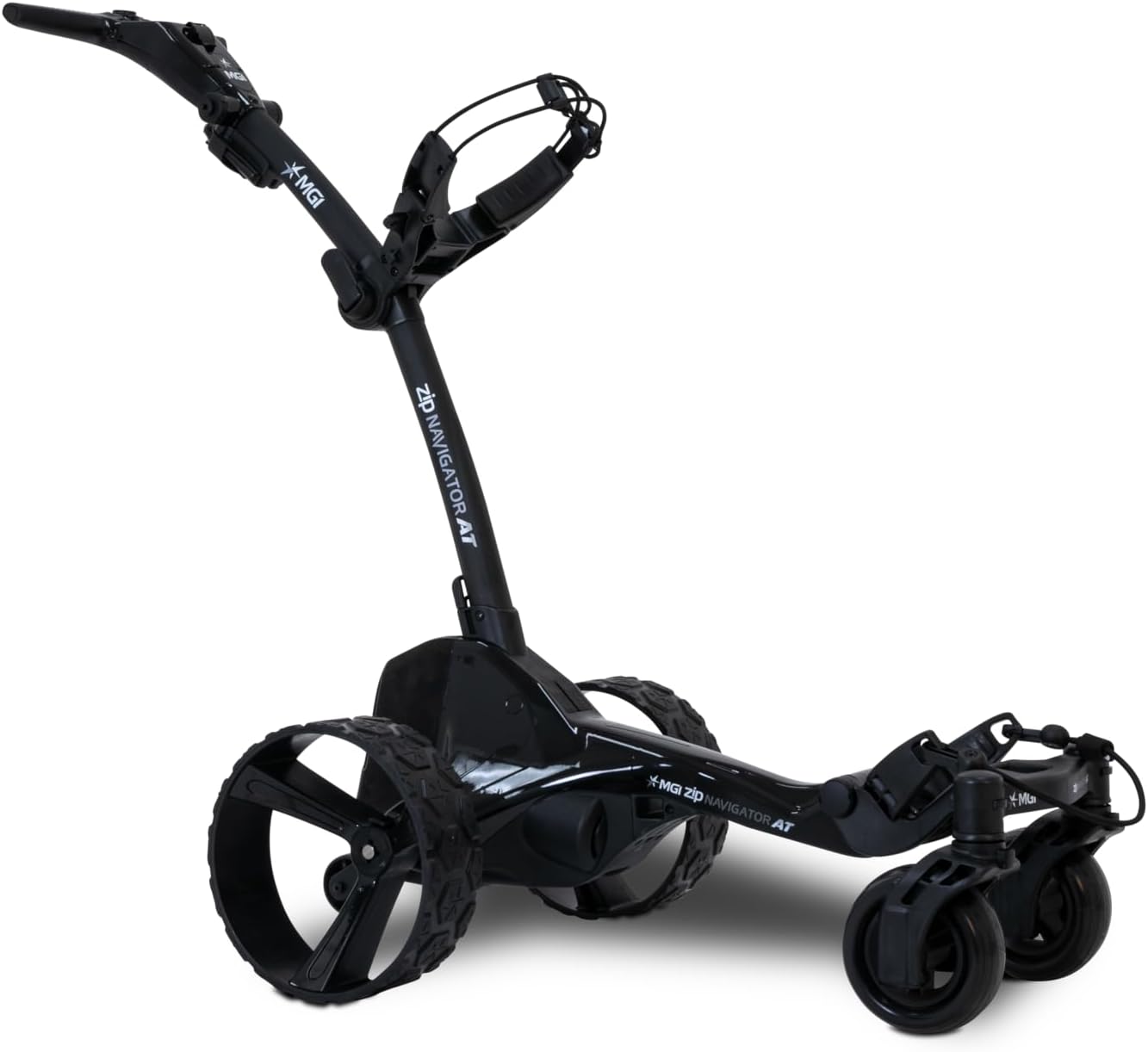
Handles hills like nothing else. The gyroscope stabilization isn’t marketing fluff—it actually works. | BUY NOW |
 |
Best Storage & Stability
|
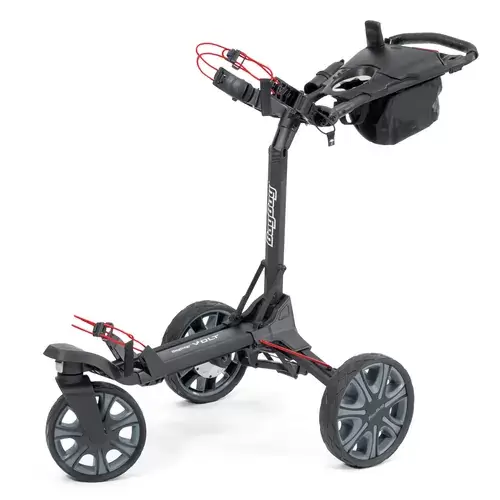
The most generous storage of any electric cart I’ve tested. Rock-solid stability and that TrueLine tracking keeps it straight. | BUY NOW |
 |
Best Value
|
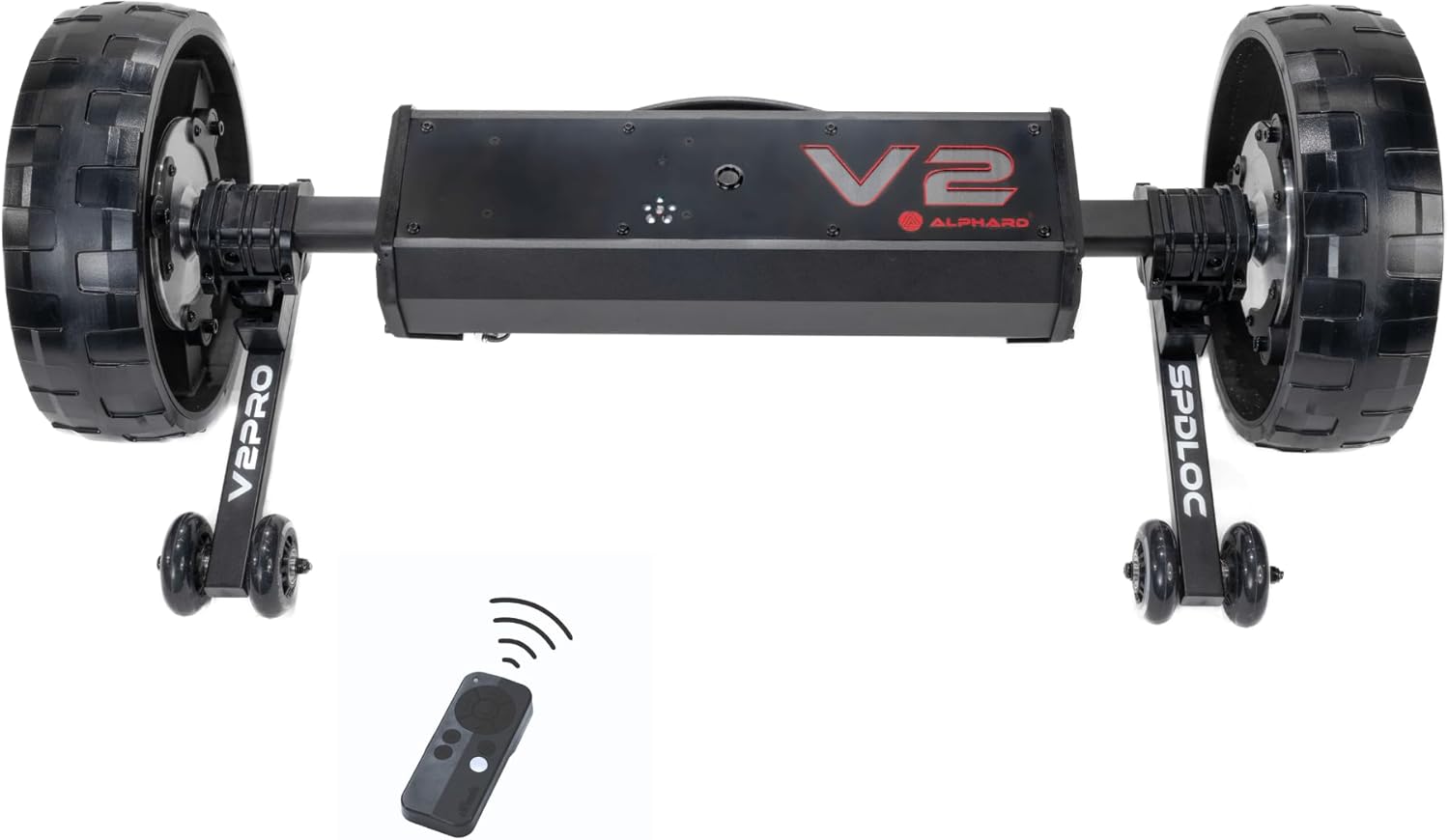
Converts your existing push cart. Saved me from buying a whole new rig when I was on a budget. | BUY NOW |
 |
Best Follow Technology
|
Follows you like a well-trained dog. Pricey, but the hands-free experience is unmatched. | BUY NOW |
 |
Best for Compact Cars
|
Fits in my Mazda 3 trunk with room to spare. Most carts can’t say that. | BUY NOW |
 |
Best Battery Life
|
Went 42 holes on a single charge during testing. The GPS integration is legitimately useful. | BUY NOW |
How We Tested These Carts
I don’t write reviews from spec sheets. Every cart on this list spent at least 4 rounds in my rotation, and most logged 6-10 rounds before I rated them.
Testing Conditions
Courses Used:
- The Federal Club (Richmond, VA) — Championship layout, varied terrain, excellent conditioning
- Raspberry Falls Golf & Hunt Club (Leesburg, VA) — Hilly, well-maintained, cart path only sections
- Grove Park Inn (Asheville, NC) — Mountain course, serious elevation changes
- Orange County National (Orlando, FL) — Flat, long walks between holes
Testing Period: March 2024 through January 2026
Conditions: Morning dew, afternoon heat (95°+), light rain, heavy rough, cart paths, and everything in between.
What We Measured
Maneuverability (25% of score): How easily does it turn? Does it fight you on tight corners? Can you navigate a crowded tee box without bumping into someone’s bag?
Battery Life (20%): Not the manufacturer’s claim—actual holes played before performance dropped. I measured this multiple times per cart.
Hill Performance (20%): This is where cheap carts fail. I specifically tested on Raspberry Falls’ back nine, which has three holes that separate the pretenders from the contenders.
Build Quality (15%): Did anything rattle loose after 10 rounds? How did it handle being thrown in and out of my trunk 50+ times?
Portability (10%): Real-world folded dimensions (I measured myself), actual weight on a bathroom scale, and whether it fits in a sedan trunk.
Features & Value (10%): GPS, cup holders, phone mounts—nice to have, but only if they actually work.
Quick Comparison Table
| CART | PRICE | WEIGHT | BATTERY LIFE | REMOTE | BEST FOR |
|---|---|---|---|---|---|
| MGI Zip Navigator AT | $1,595 | 31 lbs | 36 holes | Yes | Hilly courses & overall performance |
| Bag Boy Volt | $1,495 | 28 lbs | 36 holes | Yes | Storage & stability |
| Alphard Club Booster V2 | $839 | 12 lbs (motor only) | 18–22 holes | Yes | Value & converting existing cart |
| Stewart Golf Q Follow | $2,999 | 24 lbs | 27 holes | Follow mode | Hands‑free walking |
| QOD Golf Q2 | $1,295 | 36 lbs | 18-36 holes | Yes | Compact cars & tight storage |
| Motocaddy M7 GPS | $1,549 | 28 lbs | 36 holes | Yes | Battery life & built‑in GPS |
Detailed Reviews
MGI Zip Navigator AT — $1,595
Best Overall Pick
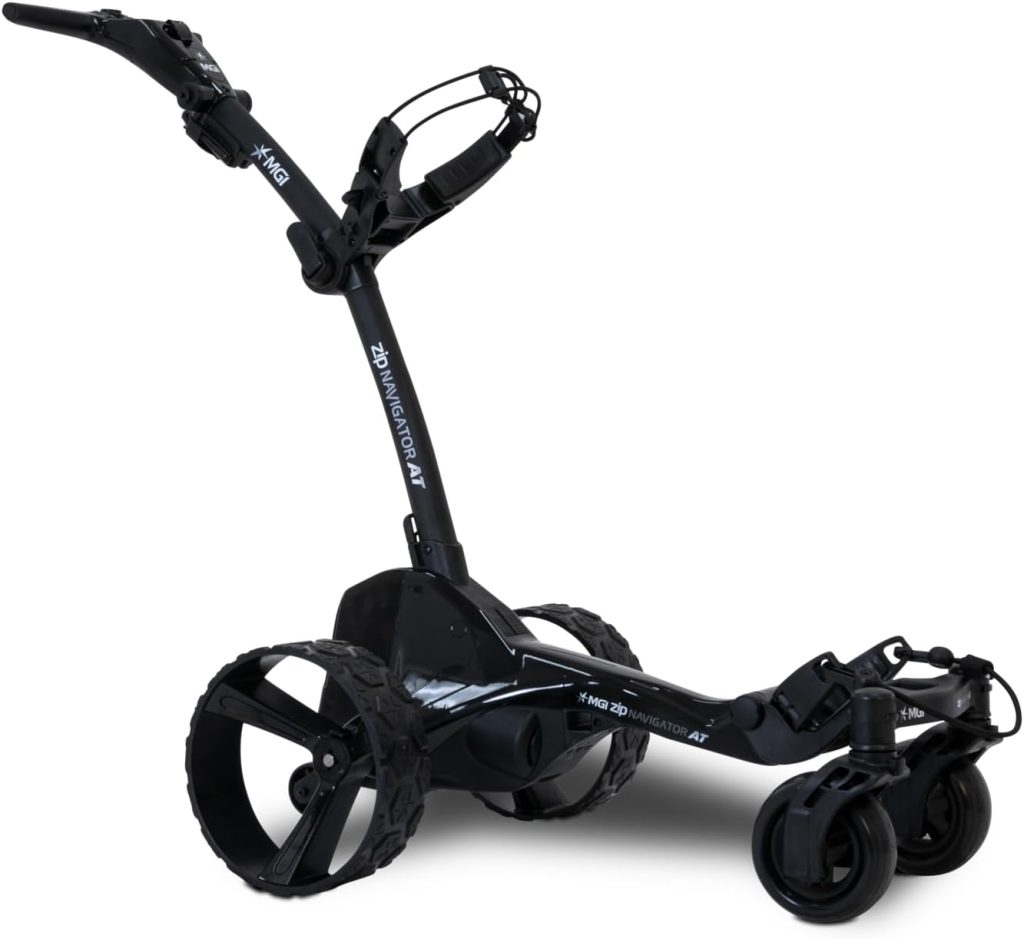
This is the cart I use for my own rounds. After testing 14 different models, this is what stays in my trunk.
The Zip Navigator AT has dual independent motors and a gyroscope stabilization system. That sounds like marketing speak until you use it on a sidehill lie. Most carts drift downhill when you’re walking across a slope—the MGI holds its line. On the steep approach to Raspberry Falls’ 12th green, this was the only cart that didn’t require constant correction.
What I Liked:
The all-terrain wheels handle wet morning grass without slipping. The remote is responsive up to about 50 yards (MGI claims 100, but real-world performance is lower). Folding takes maybe 10 seconds once you’ve done it a few times. The battery comfortably does 36 holes, and I’ve pushed it to 40 on flatter courses.
What I Didn’t:
At 26 pounds, it’s not light. If you have back issues, loading it into an SUV might be fine, but hoisting it into a sedan trunk gets old. The price is also significant—you’re paying premium money here.
Who Should Buy This:
Golfers who play hilly courses regularly. If you walk flat tracks exclusively, you can save money with other options. But if your course has any real elevation change, the gyroscope tech is worth the investment.
Specs:
- Weight: 31 lbs (with battery)
- Folded: 13″ × 17″ × 35″
- Battery: 36 holes real-world
- Remote Range: ~50 yards reliable
- Motor: Dual 230W independent
- Warranty: 2 years
Bag Boy Volt — $1,495
Best Storage & Stability — Top 3 Pick
I’m going to be direct: the Bag Boy Volt is the best electric cart I’ve used that isn’t the MGI Navigator. After 20+ rounds at The Federal Club in Richmond, I’m convinced this cart deserves more attention than it gets.
Bag Boy has been making push carts since before most golfers knew what a push cart was. The Volt takes all that engineering knowledge and wraps it around a 24V lithium battery system that just works. The TrueLine course correction software keeps the cart tracking straight—set it going and it doesn’t drift left or right like cheaper models. At The Federal Club’s long par 5s, I’d send the Volt 30 yards ahead and it stayed exactly on line.
What I Liked:
The storage is unmatched. Full-featured console with scorecard holder, phone mount, ball storage, drink holder—and a massive accessory bag underneath. I fit my rangefinder, extra balls, snacks, and rain gear without cramming. The extendable fourth wheel prevents the cart from tipping backward on uphills—a problem I’ve had with other carts. Setup takes three steps: pop in the battery, hit the lever, flip up the console. Faster than my old Clicgear, which is wild for an electric model.
The stability impressed me most. No tipping, no wobble, even when my bag shifted mid-round. At 28 pounds it’s not the lightest, but the weight is distributed low, which keeps everything planted. And that battery reliably delivers 36 holes—I’ve done back-to-back rounds without charging.
What I Didn’t:
On very steep inclines, you’ll see some wheel lift. I noticed this twice during testing—both times on slopes steeper than anything you’d find at an average course. Switching to manual mode for 20 feet solved it. The folded dimensions (29″ × 16.5″ × 14.5″) are compact but taller than some competitors, which matters if your trunk space is tight vertically.
Who Should Buy This:
Golfers who want generous storage and rock-solid stability. Players tired of carts that drift off-line. Anyone who’s had a cart tip over with their $2,000 driver in the bag. This is the cart you buy when you want something that just works, every round, without drama.
Specs:
- Weight: 28 lbs (with battery)
- Folded: 29″ × 16.5″ × 14.5″
- Battery: 36 holes (24V 380Wh lithium)
- Remote Range: ~30 yards reliable
- Motor: Dual motors, 9 speed levels
- Features: TrueLine tracking, distance control (5-30 yards), Top-Lok bag compatibility
- Warranty: 1 year
Stewart Golf Q Follow — $2,999
Best Follow Technology
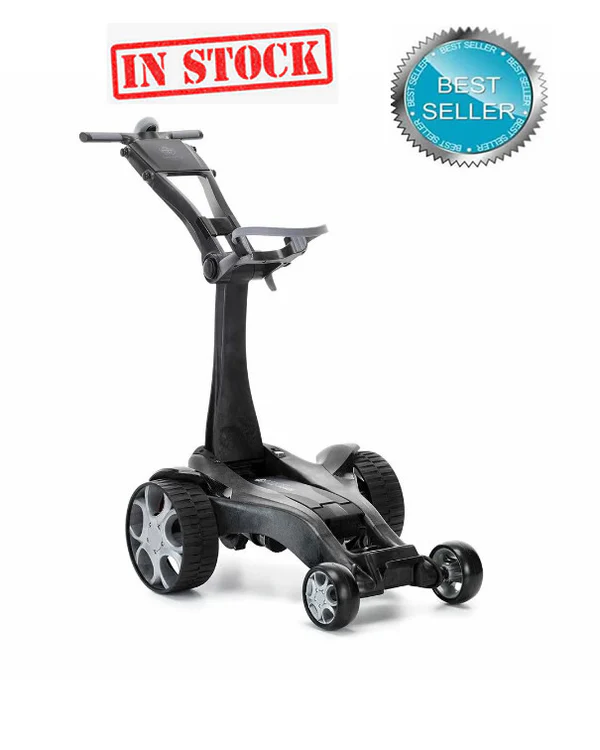
I’ll be honest—I thought follow technology was a gimmick before testing the Stewart. I was wrong.
The Q Follow uses a combination of Bluetooth and sensors to track your movement and follow 2-3 paces behind. You wear a small handset on your belt, and the cart follows your walking path. No remote needed for basic operation.
During testing at Fed, I walked 18 holes without touching the cart once after setup. It followed me up hills, around corners, and stopped when I stopped. The tracking accuracy was impressive—it only lost me twice in 15 rounds, both times in areas with heavy tree coverage.
What I Liked:
The hands-free experience is genuinely liberating. Your hands are free to carry a club, eat a snack, or just walk naturally. The build quality is exceptional—this feels like a luxury product because it is one. The folding mechanism is elegant and quick.
What I Didn’t:
That price. $2,999 is a lot of money for a push cart, period. The battery life is adequate (27 holes) but not exceptional for this price point. The follow feature doesn’t work well in very crowded situations—if someone walks between you and the cart, it can get confused.
Who Should Buy This:
Golfers who play primarily at private clubs with lighter traffic and want the premium hands-free experience. If you’re frequently playing crowded municipal courses with groups stacking up, the follow feature loses some value.
Specs:
- Weight: 24 lbs (with battery)
- Folded: 13″ × 15″ × 33″
- Battery: 27 holes
- Follow Range: 15-20 yards
- Motor: Dual 200W
- Warranty: 2 years
Alphard Club Booster V2 — $839
Best Value / Best Conversion Kit
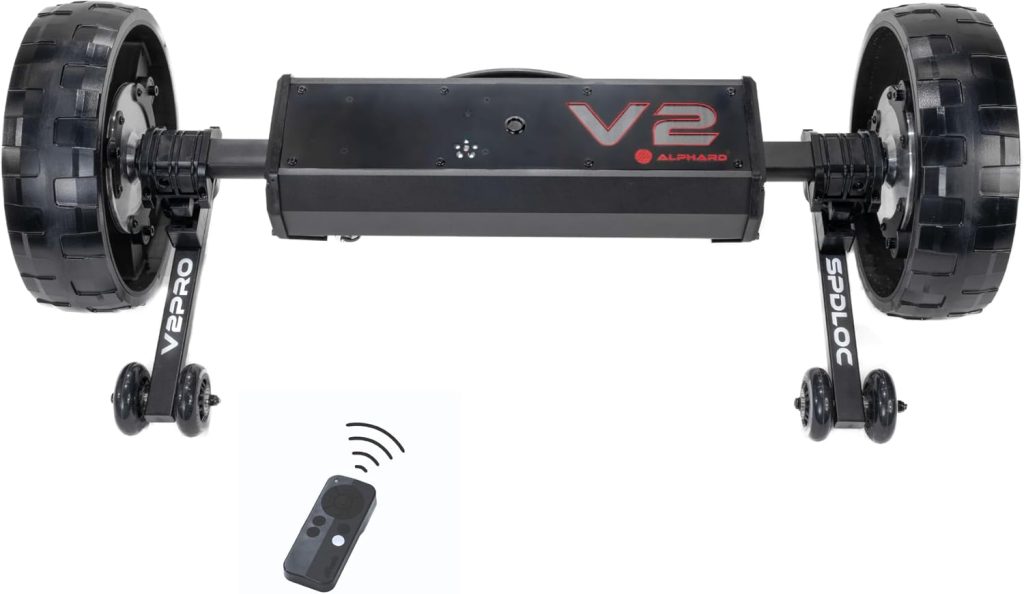
Here’s the thing about electric carts—you might already own half of one.
The Club Booster V2 converts your existing push cart into an electric cart. It attaches to your rear axle and adds motorized drive to whatever you’re already using. I tested it on a Clicgear 4.0 and a Sun Mountain Speed Cart, and it worked seamlessly with both.
This is how I started with electric carts. I wasn’t ready to drop $1,500+ on a dedicated unit, so I spent $839 and converted my Clicgear. Three years later, it still works perfectly.
What I Liked:
The value proposition is obvious—$839 versus $1,500+ for a full cart. Installation takes 5 minutes. The remote works well up to 30 yards. You keep the push cart you already know and like. If the motor ever dies, you still have a functional manual cart.
What I Didn’t:
Battery life is adequate but not impressive—18 holes is realistic, 27 is pushing it on hilly courses. The motor is less powerful than dedicated units, so very steep hills require some manual assistance. It adds 12 lbs to your existing cart, which can make the total package heavier than buying an integrated unit.
Who Should Buy This:
Golfers who already own a good push cart and want to try electric without the full investment. Golfers on a budget who still want powered assistance. Travelers who want to detach the motor and have a lightweight manual cart for airline travel.
Compatible Carts: Clicgear 3.5/4.0/8.0, Sun Mountain Speed Cart, Bag Boy Quad, CaddyTek 3-wheel, most major brands.
Specs:
- Weight: 12 lbs (motor unit only)
- Battery: 18-22 holes
- Remote Range: ~30 yards
- Motor: Single 200W
- Warranty: 1 year
QOD Golf Q2 — $1,295
Most Compact
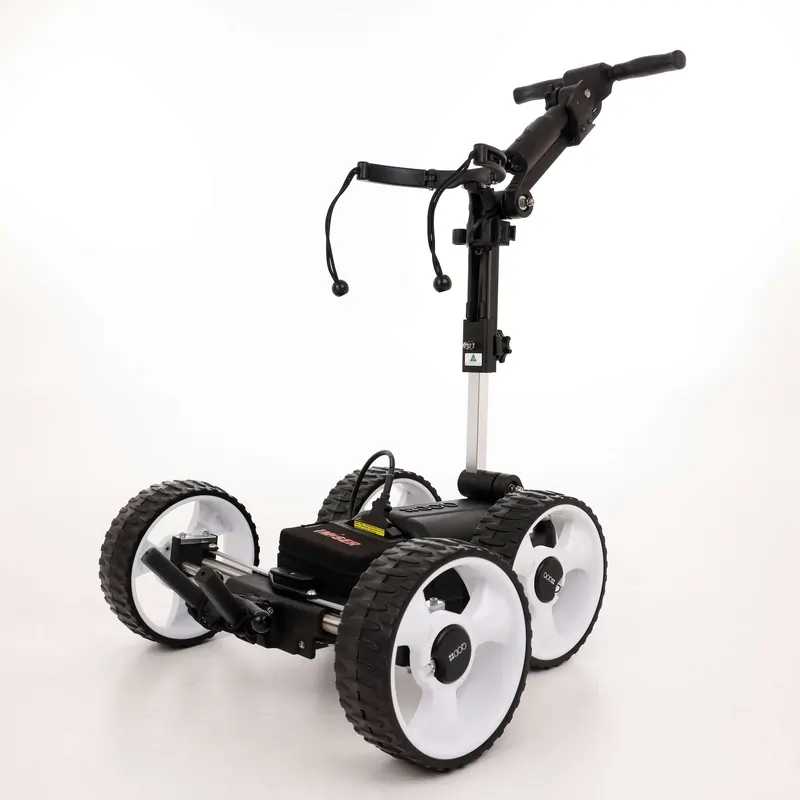
If you drive a sedan, you know the struggle. Most electric carts don’t fit in smaller trunks—or they fit, but only if you remove your travel bag, move the seats forward, and pray.
The QOD Q2 solves this. Folded dimensions are 10″ × 14″ × 29″—the smallest I’ve tested by a significant margin. It fits in my Mazda 3 with room for my bag beside it. That’s not marketing; I measured it myself.
What I Liked:
The compact size doesn’t sacrifice much performance. Hill handling is solid (not MGI-level, but good). The build quality is better than expected at this price point. Weighing only 19 pounds, it’s easy to lift even for golfers with back issues. The folding mechanism is genuinely quick—I can fold it in under 10 seconds.
What I Didn’t:
The smaller frame means less stability on very rough terrain. The battery compartment is tight, making swaps slightly awkward. Storage space on the cart itself is limited—if you like mounting lots of accessories, look elsewhere. The 27-hole battery life is fine but not exceptional.
Who Should Buy This:
Sedan drivers. Golfers with limited garage storage. Anyone who’s ever struggled to fit a full-size cart in their trunk. Also a great choice for golfers who frequently fly and want something that packs small.
Specs:
- Weight: 19 lbs (with battery)
- Folded: 10″ × 14″ × 29″
- Battery: 18-36 holes depending on conditions
- Remote Range: ~40 yards
- Motor: Dual 180W
- Warranty: 2 years
Motocaddy M7 GPS — $1,549
Best Battery Life & GPS Integration
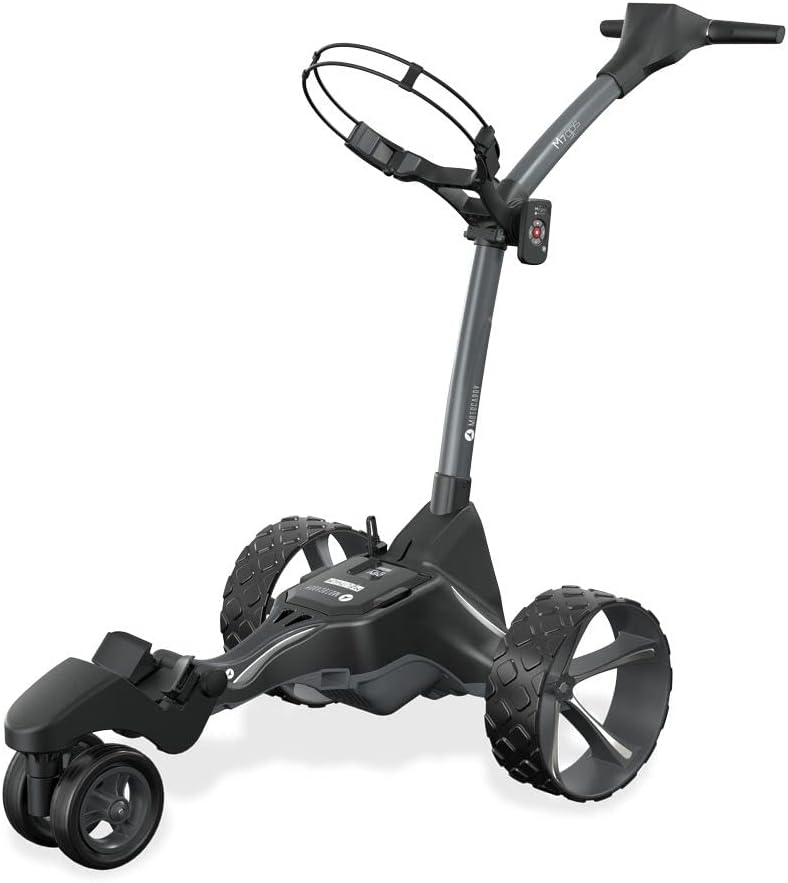
Motocaddy has been making electric trolleys in the UK longer than most American golfers have known they existed. The M7 GPS is their flagship, and the experience shows.
The standout feature is battery life. During testing, I got 42 holes on a single charge at The Fed Club—that’s 2.3 rounds without plugging in. If you’re the type who plays 36 holes on a Saturday or forgets to charge between rounds, this cart covers you.
The integrated GPS shows distances to front/center/back on a built-in display. It’s not as detailed as a dedicated GPS watch, but it’s useful for quick reference without pulling out your phone.
What I Liked:
That battery life is legitimately best-in-class. The GPS integration is well-executed—no subscription fees, free updates via USB. Build quality is excellent; Motocaddy clearly has the manufacturing figured out. The downhill speed control works well on steep descents.
What I Didn’t:
The folded size is on the larger end, which creates trunk issues for compact car drivers. At 28 pounds, it’s one of the heavier options. The GPS screen is small and hard to read in direct sunlight. UK-designed, so some accessories use metric measurements.
Who Should Buy This:
Golfers who play long days (36+ holes). Golfers who want integrated GPS without carrying another device. Players who value proven build quality and don’t want to charge between rounds.
Specs:
- Weight: 28 lbs (with battery)
- Folded: 12″ × 16″ × 34″
- Battery: 36 holes
- Remote Range: ~50 yards
- Motor: Single 230W
- Warranty: 2 years
Buying Guide: How to Choose the Right Electric Cart
Budget Realities
- Under $900: You’re looking at conversion kits (Club Booster V2) or used markets. Nothing wrong with either—I started here.
- $1,000-$1,300: Entry-level complete carts. Adequate for flat courses, acceptable on moderate hills. The sweet spot for most recreational golfers.
- $1,300-$1,700: Mid-range performance. Better motors, longer battery life, smoother operation. Where quality starts to really differentiate.
- $1,700-$2,000: Premium features like integrated GPS, superior hill handling. Diminishing returns for casual players, noticeable difference for serious walkers.
- $2,000+: Follow technology territory. Only worth it if you’ll actually use the hands-free feature regularly.
Course Terrain Matters
- Flat Courses: Save your money. A $1,099 cart will perform nearly identically to a $1,595 cart on flat terrain. Don’t overspend for features you won’t use.
- Moderate Hills: Mid-range carts handle these fine. Gyroscope stabilization is nice but not essential. The Bag Boy Volt handles moderate hills without drama.
- Serious Elevation: This is where premium carts justify their price. The MGI Navigator AT’s gyroscope made a real difference on mountain courses in my testing. Cheap carts drift; good ones hold their line.
Portability Considerations
- Sedan Drivers: Check folded dimensions carefully. The QOD Q2 (10″ × 14″ × 29″) fits where others don’t.
- SUV/Truck Owners: Less of a constraint, but weight still matters for loading/unloading. Anything over 26 lbs gets old after a few months.
- Frequent Flyers: Look at conversion kits or the most compact options. Full electric carts are a hassle to travel with.
Battery Life Needs
- 18 holes only: Most carts cover this easily. Don’t overpay for battery capacity you won’t use.
- 27-36 holes: You play long days. Motocaddy M7 (42 holes), Bag Boy Volt (36 holes), or PowaKaddy CT8 (36 holes) are your friends.
- Forgetful chargers: Get something with 36+ hole capacity so a missed charge doesn’t ruin your round.
Features Worth Paying For
- Gyroscope stabilization: Worth it on hilly courses. Skip it if your course is flat.
- GPS integration: Nice if you don’t carry a watch or phone for distances. Redundant if you already have GPS solutions.
- Follow technology: Only worth the premium if you genuinely want hands-free walking most of the time.
- TrueLine/course correction: Underrated. The Bag Boy Volt’s tracking software keeps it moving straight without constant adjustment. Makes a real difference over 18 holes.
- Quality remotes: Underrated feature. A responsive, well-designed remote makes daily use much more pleasant.
Features to Ignore
- Cup holder quantity: One good one is enough.
- Phone charging: Your phone has enough battery for 18 holes. This solves a problem that doesn’t exist.
- Bluetooth speakers: Please don’t be that person.
- Gimmicky accessories: Focus on the cart itself, not the extras.
Frequently Asked Questions
How long do electric golf cart batteries last before needing replacement?
Most lithium batteries last 500-700 charge cycles before noticeably degrading. If you play twice a week, that’s 5-7 years of use. Replacement batteries run $200-400 depending on brand. I’ve been using the same MGI battery for three years without issues.
Can I use an electric push cart in the rain?
Yes, all carts I tested are water-resistant for normal golf conditions. I’ve used mine in light rain multiple times without problems. That said, I wouldn’t submerge them or leave them out in a downpour. When you finish a wet round, wipe down the electronics and let it dry before storing.
Are electric push carts allowed on all courses?
Almost universally, yes. I’ve never been turned away from a course with an electric push cart. Some courses have cart path restrictions that apply equally to manual and electric carts. A few exclusive clubs prefer caddies, but that’s about image, not rules.
What’s the actual battery life versus what manufacturers claim?
Manufacturers measure in ideal conditions—flat terrain, moderate temperature, no heavy bag. Real-world results are typically 10-20% lower. When I say a cart does “36 holes,” that’s what I actually got during testing, not the marketing number.
Do I need a follow cart, or is remote control sufficient?
Remote control is sufficient for 95% of golfers. Follow technology is cool but not essential. I use remote control mode on my MGI Navigator despite it having follow capability—the remote gives me more precise control in tight situations. Buy follow tech because you genuinely want hands-free walking, not because it sounds impressive.
How heavy is too heavy for lifting in and out of a trunk?
Depends on your physical condition. For me, 25-26 lbs is comfortable. Over 28 lbs gets noticeable after a season of use. If you have back or shoulder issues, prioritize lighter carts—the QOD Q2 at 19 lbs is significantly easier to handle than the Motocaddy M7 at 28 lbs.
Can I take an electric golf cart on an airplane?
Technically challenging. Lithium batteries have airline restrictions. Most golfers either ship batteries separately or use conversion kits (remove the motor and battery, fly with just the manual cart). This is where the Club Booster shines—you can detach it and travel with a normal push cart.
Manual vs. electric—is the upgrade worth it?
If you walk more than twice a month and your course has any meaningful terrain, yes. My scoring improved, my energy levels improved, and my enjoyment improved. The $1,000+ price tag pays for itself in better rounds. If you only walk occasionally on flat courses, stick with manual.
How long does charging take?
Most carts charge fully in 4-6 hours from empty. The Bag Boy Volt charges in about 4 hours. I plug mine in when I get home from a round and it’s ready by the next morning. Fast charging exists on some models but adds cost.
What’s the difference between electric push cart, trolley, and caddy?
Same thing, different regions. Americans say “cart,” Brits say “trolley,” some brands say “caddy.” Electric push carts and electric caddies are identical products. Don’t get confused by marketing terminology.
Maintenance Tips
After Every Round:
- Wipe down wheels and frame
- Check for grass buildup around axles
- Store indoors (temperature extremes hurt batteries)
Monthly:
- Check tire pressure if applicable
- Tighten any loose screws
- Clean battery contacts with dry cloth
Seasonally:
- Full deep clean
- Firmware updates if your cart supports them
- Battery conditioning (full charge, full drain, full charge)
Winter Storage:
- Store battery at 40-60% charge (not full, not empty)
- Keep in climate-controlled space
- Don’t leave in cold garage
Update History
- February 2026: Complete refresh. Promoted Bag Boy Volt to top 3. Updated all pricing. Refreshed testing data from winter rounds at The Federal Club.
- November 2025: Added 6-month durability notes on MGI Navigator. Updated battery life data across all models.
- August 2025: Added CaddyTrek R3 review. Updated Stewart Q Follow with follow-technology comparison data.
- May 2025: Seasonal refresh. Pricing updates. Added tips for hilly course selection.
- January 2025: Initial comprehensive testing complete. First publication.
Final Thoughts
After dozens of rounds with these carts, the MGI Zip Navigator AT remains my top overall pick for its unmatched hill performance. But the Bag Boy Volt has earned its spot in my top 3—the storage, stability, and TrueLine tracking make it a workhorse you can trust round after round. For budget-conscious golfers, the Club Booster V2 conversion kit remains the smartest entry point into electric carts.
The “best” cart depends on your specific situation. If trunk space is tight, the QOD Q2 solves a real problem. If you want hands-free walking, the Stewart Q Follow delivers—at a price.
The most important thing is to start walking. These carts exist to make walking golf more enjoyable, and they succeed at that regardless of which one you choose. Pick the cart that fits your budget and your trunk, and go play.