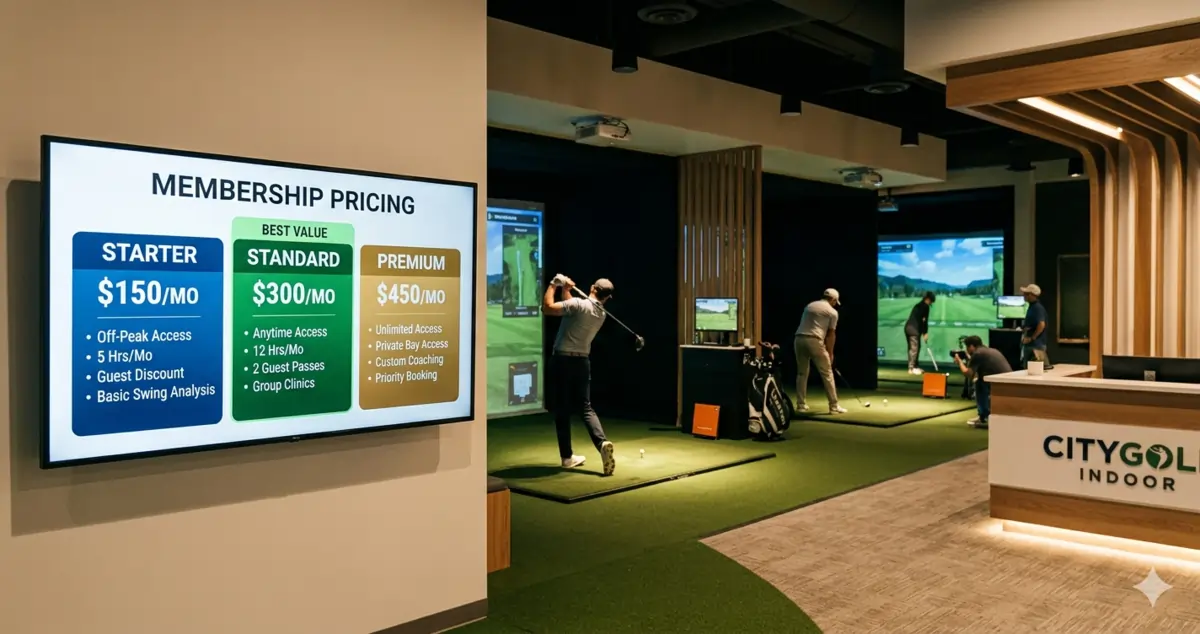
Most indoor golf operators get membership pricing wrong in the same direction: too cheap to be sustainable, too complicated to sell, or both. This guide breaks down the real market data, the three-tier framework that works, and the variables that should be driving your numbers.
Walk into any indoor golf forum or operator group and you’ll find the same membership pricing thread repeating itself. Operators share their numbers, everyone has a different answer, and nobody can explain the logic behind what they settled on. The market has matured enough that you don’t have to guess anymore.
This article covers what the current market actually looks like, how to build a pricing structure that accounts for your costs and your market position, and the mistakes that cause promising venues to leave money on the table or price themselves into a churn spiral. Our custom financial plan helps you get exactly the information you need to run the business you want.
- 01What the Market Is Currently Charging
- 02The Three-Tier Membership Framework
- 03The Cost Math Behind Your Membership Price
- 04Hourly vs. Membership: How to Balance Both
- 05Seasonal Churn and How to Fight It
- 06What to Bundle to Justify Higher Prices
- 07Corporate and Group Membership Tiers
- 08Pricing Mistakes That Kill Member Revenue
What the Market Is Currently Charging
The indoor golf membership market has consolidated around two price bands. Most venues land somewhere in the $150 to $300 per month range for individual memberships, with walk-in hourly rates running $30 to $75 per hour. There are outliers on both ends, but these are the numbers you’re competing against in most markets.
The wide range in membership pricing reflects the wide range in what memberships actually include. A $150/month plan at a bare-bones two-bay operation looks nothing like a $300/month plan at a full-service venue with leagues, instruction, and a bar. Comparing prices without comparing what’s in the package is how operators end up undervaluing their own product.
At the ultra-low end, one Neighborhood National operator reported running a $70/month unlimited-use model. That kind of price point can make sense for someone who has a simulator at home and is looking to offset the cost by bringing in a small circle of paying members, rather than building a commercial venue from the ground up.
| Membership Type | Typical Price Range | Included Hours | Best For |
|---|---|---|---|
| Entry / Off-Peak | $80–$150/mo | 6–10 hrs/mo, off-peak only | Casual players, price-sensitive market |
| Core / Standard | $150–$250/mo | 10–15 hrs/mo, anytime booking | Most venues’ primary membership tier |
| Premium / Unlimited | $250–$400/mo | Unlimited or 20+ hrs/mo | High-frequency players, affluent markets |
| Corporate / Team | $400–$800/mo | 10–20 hrs/mo, multi-user access | Business entertainment, team outings |
| Annual Prepay | 10–20% discount on monthly rate | Same as chosen tier | Cash flow boost, commitment signal |
The Three-Tier Membership Framework
Venues that thrive on membership revenue almost universally run three tiers. Not two, not five. Three. Two tiers leave money on the table from members who would pay more for more access. Five tiers create decision paralysis and a staff training nightmare. Three tiers with clear differentiation is the sweet spot.
- 6–8 hours/month
- Off-peak hours only (Mon–Thu before 4pm)
- Booking window: 48 hours in advance
- Member-rate guest fees
- No rollover hours
- 12–15 hours/month
- Any-hour booking access
- Priority booking window (72 hrs)
- 1 guest pass/month included
- League and event priority signup
- Unlimited hours (or 25+ hrs/mo bank)
- First booking window (96 hrs)
- 2 guest passes/month included
- Complimentary club fitting session
- Priority for league captaincy
The specific dollar amounts within each tier depend on your market and your cost structure, which we’ll get to below. The structure itself, however, is consistent across successful venues. Each tier should feel distinctly more valuable than the one below it, not just incrementally more expensive.
The “most popular” badge on Tier 2 is not just a marketing gimmick. It is directionally useful information for the buyer. Most of your prospects are uncertain about which tier fits them. A subtle signal that the middle option is the one most people choose reduces friction and prevents them from defaulting to your cheapest option out of caution.
The Cost Math Behind Your Membership Price
Before you set a single price, you need to know your cost per bay per hour. That number, not what your competitors charge, is the floor under your pricing. Charging below your floor because someone nearby is cheaper is how venues go out of business with full booking calendars.
Work backward from your monthly fixed costs. Total your rent, utilities, simulator lease or loan payments, software subscriptions, insurance, and any staffing. Divide by the number of available bay-hours in your operating schedule. That is your break-even cost per bay-hour before a single dollar of profit.
| Venue Size | Typical Monthly Fixed Costs | Available Bay-Hours/Mo | Break-Even $/Bay-Hour |
|---|---|---|---|
| 2-Bay Micro Venue | $4,000–$8,000 | 480–600 | $7–$17 |
| 3–4 Bay Mid-Size | $10,000–$18,000 | 720–960 | $11–$25 |
| 5–8 Bay Full Venue | $20,000–$40,000 | 1,200–1,920 | $10–$33 |
A 4-bay venue running at 60% utilization with an average $50 hourly rate generates roughly $4,000 to $5,500 per bay per month in simulator revenue alone. Add memberships, events, and any food and beverage, and well-run facilities reach $6,000 to $8,000 per bay monthly. Those numbers produce a 4-bay gross of $16,000 to $32,000 per month before expenses.
Now apply membership math on top. If your Core tier includes 12 hours per month at $200, that’s $16.67 per hour billed to the member. Your actual cost per bay-hour (from the table above) needs to be well below that. If it isn’t, unlimited or high-hour memberships are being subsidized by your walk-in business, which is a structural problem, not a pricing strategy.
Unlimited memberships attract exactly the wrong customer: the high-frequency user who maxes out their hours every single month. At $250/month unlimited, a member booking 20 hours costs you $12.50 per hour billed against your actual costs. If your break-even is $15/bay-hour, you are losing money on every heavy user in the program. Hour banks with a monthly cap are a more sustainable alternative for most venues.
Need to stress-test your numbers before you set your prices? Our indoor golf business financial model lets you model membership revenue alongside hourly, events, and F&B so you can see your break-even and margin structure before you commit to a pricing menu.
Run the Numbers Before You Set Your Prices
Our indoor golf startup financial model and business study give you the framework to model membership revenue, break-even timelines, and bay utilization before you open your doors or change your pricing.
Access the Financial ModelHourly vs. Membership: How to Balance Both
The best-performing indoor golf venues don’t choose between hourly and membership revenue. They structure both so that each serves a different customer segment without cannibalizing the other.
Walk-in hourly pricing fills your discovery funnel. First-time visitors, occasional players, and event groups almost always start as hourly customers. Your job is to convert the right percentage of them into members without giving memberships away so cheaply that walk-in revenue collapses.
During peak hours, members-only models often generate just one-third the revenue per bay compared to hourly bookings. You’re filling your most valuable time slots with discounted usage.
Birrdi, Indoor Golf Business Analysis 2024The implication of that data is not that memberships are bad. It is that you should not be unlimited-membershipping your way through peak Friday evening slots when walk-in demand would fill those same bays at full hourly rate. Structure your memberships to drive off-peak utilization, and let demand pricing work during peak windows.
A practical split that works for many venues: members get priority booking up to 72 hours out, with some peak-hour limitations on lower tiers. Walk-in and online booking fills the gaps, often at a slight peak surcharge. You get both the predictable membership base and the revenue-per-bay ceiling on your best hours.
| Revenue Stream | Best For | Revenue Predictability | Revenue per Bay-Hour |
|---|---|---|---|
| Walk-in / Hourly | Peak hours, first-timers, groups | Low (variable) | Highest ($40–$75) |
| Memberships (hour bank) | Off-peak fill, loyal regulars | High (recurring) | Medium ($15–$25 effective) |
| Leagues | Fixed schedule fill, community | High (seasonal) | Medium ($20–$35) |
| Private Events | Corporate, celebrations | Low (sporadic) | Highest ($50–$120+) |
Seasonal Churn and How to Fight It
Seasonal churn is the indoor golf membership problem that most pricing guides don’t talk about directly. When outdoor courses open in the spring, a meaningful chunk of your membership base cancels. This is not a failure of your product. It is the nature of a seasonal complement.
One operator benchmark is instructive: model membership retention over six to seven solid months, not twelve. This is a more realistic forecast for venues in northern climates, and it protects you from building a financial model on annual retention assumptions that won’t hold.
The countermeasures are structural, not just promotional. Annual prepay options at a 10 to 15 percent discount lock in the commitment before the spring exodus. Summer programming, junior camps, and fitness-integrated simulator use (club fitting, swing analysis packages) give members reasons to stay active even when the outdoor season is running. Leagues scheduled on fixed days create social accountability that walk-in access never does.
A well-structured membership program should reach 30 to 50 active members within 6 months and contribute 25 to 40 percent of your total monthly revenue within a year. If you’re not hitting those numbers, the problem is usually in the tier structure or the member acquisition funnel, not the headline price.
What to Bundle to Justify Higher Prices
The fastest way to raise your membership prices without losing members is to add genuine value to what the membership includes. The key word is genuine. A “priority booking” perk that doesn’t actually give the member any practical advantage is noise. A dedicated tee time window that consistently gets them bays when walk-in traffic can’t is real value.
Here are the add-ons that move the needle on member retention and perceived value at indoor golf venues:
Guest passes. Including one or two guest passes per month adds genuine social value and doubles as your best acquisition tool. Members bring friends who become members.
League priority and captaincy. Leagues fill your slowest booking windows, build community, and give members something to look forward to outside of solo practice sessions. Priority signup access for members is a low-cost, high-perceived-value benefit.
Instruction credits. If you have a teaching professional on staff or a partnership with a local instructor, a monthly lesson credit or discounted lesson rate is a compelling reason to stay on a premium tier. It also differentiates your venue from the pure-entertainment facilities that aren’t investing in the game.
Equipment discounts. A standing discount at your pro shop or with a partner retailer costs you little and signals that the membership extends beyond the bays. Members who spend money with you beyond their monthly dues have higher lifetime value and lower churn rates.
Bring-a-buddy hours. Beyond the formal guest pass, allowing premium members to bring a guest during off-peak hours at no charge encourages usage and keeps members coming in consistently throughout the month.
Does Your Membership Model Change Your Insurance Requirements?
Moving from walk-in only to a recurring membership structure can affect your liability exposure, your property coverage needs, and what your landlord requires in your COI. Make sure your policy reflects how you actually operate. Get a quote built specifically for indoor golf venues.
Get an Indoor Golf Insurance QuoteCorporate and Group Membership Tiers
Corporate memberships are the most underbuilt revenue stream at the average indoor golf venue. A company doesn’t buy a membership for the golf. They buy it for client entertainment, team building, and something to put on the company card that isn’t a golf club initiation fee. That positioning changes what you charge and how you sell it.
A corporate tier priced at $400 to $800 per month is not uncommon at venues in business-dense markets. At that price point, you’re typically offering multi-user access, a designated weekly booking window, a company-branded leaderboard or account page, and the ability to expense the cost as a business entertainment line item without the friction of hourly invoicing.
| Corporate Tier | Price Range | What’s Included | Target Buyer |
|---|---|---|---|
| Small Business | $300–$450/mo | 10 hrs/mo, 2 named users, monthly invoice | Owner-operators, small firms |
| Business | $500–$700/mo | 20 hrs/mo, 4 named users, account management | Mid-size companies, sales teams |
| Enterprise | $800–$1,500/mo | Unlimited access window, dedicated bay reservation, private event credits | Large companies, hospitality budgets |
Corporate membership sales require a different outreach strategy than individual memberships. The buyer is typically an office manager, executive assistant, or HR director, not a golfer. Lead with the entertainment and team-building framing, the convenience of a monthly invoice over per-visit expensing, and the private availability of reserved bay time. The golf is secondary to the business utility.
Pricing Mistakes That Kill Member Revenue
A few patterns show up consistently at venues that are struggling to build a sustainable membership base despite having a quality product.
Copying nearby prices without knowing underlying costs. If the place across town is charging $150/month, it means nothing without knowing their rent, their equipment situation, and whether they’re actually profitable at that price. Set your floor based on your costs, then price to your market, not the other way around.
Offering unlimited access too early. Unlimited memberships are attractive to prospects but economically risky to the operator. Heavy users who book 15 or more hours per month at a flat rate erode your per-hour economics. Start with hour banks, graduate to unlimited only if your utilization patterns support it.
Not having an annual option. Monthly-only memberships make it easy for seasonal churners to disappear in April. An annual prepay at a 10 to 15 percent discount gives the committed member an incentive to lock in and gives you the cash flow visibility to plan.
Failing to explain the value gap. If your Core tier and Premium tier feel similar to a prospect, the prospect buys Core or doesn’t buy at all. Make the value gap between tiers vivid, concrete, and easy to articulate. Your staff should be able to explain the difference in 30 seconds without looking at a menu.
Underpricing the entry tier to attract volume. A $75/month entry tier is not a funnel into higher tiers. It trains your market to expect low prices and makes it harder to sell the tiers that actually support your business. Entry-level members rarely upgrade. Price your entry tier to be genuinely accessible, not to be the cheapest thing you can offer.
Indoor golf membership pricing is not a guessing game or a competitive benchmarking exercise. It starts with your cost per bay-hour, builds upward through a clear three-tier structure, and gets differentiated by perks that members actually value. The $150 to $300 range is where most markets have settled for core individual memberships, but the right number for your venue depends on your cost base, your market, and what’s in the package. Run the math first. Then price to the market with confidence.
Model Your Membership Revenue Before You Commit to a Number
Our Indoor Golf Business Study and 3-Year Financial Model let you project membership revenue across tiers, model seasonal churn, and see your path to profitability with real operator data built in. Also explore our full cost breakdown at our startup cost guide.
Access the Business HubFor a full breakdown of what it costs to get your doors open, see our guide to indoor golf business startup costs.
The Golf Simulator Insurance Program is offered through CoverMyNiche, LLC, a licensed insurance wholesaler. Neither Yardstick Golf nor [Sub-Partner] is a licensed insurance producer, and neither is authorized to sell, solicit, or bind insurance. I/we may receive a referral fee if you purchase coverage through this link.