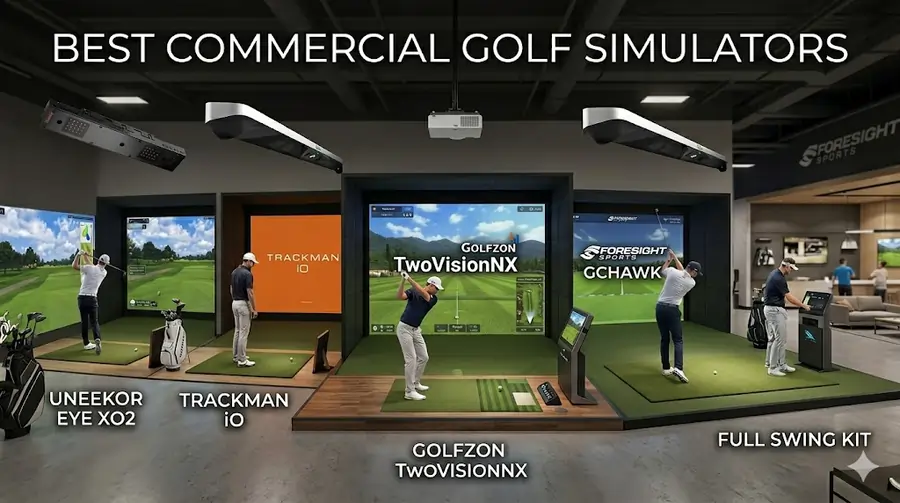
Picking the wrong simulator for a commercial venue is a $20,000 to $70,000 mistake that is very hard to walk back. This guide cuts through the marketing language and gives you a straight comparison of the simulators that actually hold up under daily commercial use.
The keyword “best commercial golf simulator” gets searched hundreds of times a month by people who are actively building or expanding indoor golf businesses. Most of what they find online is written by reviewers who have never operated a commercial venue. The evaluation criteria for a home setup and a venue that runs three to six bays eight to twelve hours a day are completely different.
What follows is grounded in published specs, manufacturer documentation, and the operational reality of running a simulator business. No fabricated durability scores. No “we tested dozens of units” language that doesn’t hold up to scrutiny. Just what each system actually does, what it costs, and which operator profile it fits.
Your technology choice is one line item in a much larger startup budget. Before committing to a simulator package, make sure you have modeled your full buildout costs. The full cost breakdown for starting an indoor golf business covers equipment, construction, legal, insurance, and working capital so you know what you are actually signing up for.
- 01Radar vs Photometric: The Technology Decision That Changes Everything
- 02What Separates a Commercial Simulator from a Home Setup
- 03Uneekor EYE XO2
- 04TrackMan iO
- 05Golfzon TwoVisionNX
- 06Foresight Sports GCHawk
- 07Full Swing KIT
- 08Side-by-Side Comparison
- 09Which Simulator Fits Which Operator
- 10What to Sort Out Before You Buy
Radar vs. Photometric: The Technology Decision That Changes Everything
Every commercial simulator uses one of two underlying tracking technologies: radar (Doppler-based) or photometric (camera-based). They are not interchangeable, and the distinction has real consequences for your room design, lighting setup, and operator workflow.
Radar systems bounce microwave signals off the ball and club to calculate velocity, spin, and trajectory. TrackMan iO uses this approach, combined with infrared and high-speed imaging. Radar generally requires specific mounting geometry and enough room behind the player for the signal to resolve. The upside is that these systems tend to be less sensitive to ambient lighting conditions.
Related Resource
Ready to take the next step?
Our complete guide walks you through every phase of opening an indoor golf simulator business — from validating your market and choosing a location to equipment, insurance, pricing, and your first 90 days of operations.
Starting a Golf Simulator Business →Photometric systems use high-speed cameras to capture the ball and club at impact, calculating data from actual images. The Uneekor EYE XO2 and Foresight GCHawk both use photometric technology. Camera-based systems typically need more controlled lighting to perform consistently, but they deliver direct measurement of ball behavior at impact rather than calculated estimates.
Photometric systems mounted overhead require consistent, controlled lighting in your bay. If your venue has windows that introduce variable natural light, you need window treatments or a fully enclosed bay before the technology can perform reliably. Design your space around your launch monitor, not the other way around.
Golfzon’s TwoVisionNX is a different category entirely. It is a turnkey self-contained simulator system with a proprietary motion-sensing platform built in. It does not pair with third-party software or launch monitors. You are buying the Golfzon ecosystem, which is a meaningful tradeoff that cuts both ways.
What Separates a Commercial Simulator from a Home Setup
The short answer: duty cycle, software licensing, and support.
A home simulator runs a few hours a week. A commercial bay runs 40 to 80 hours a week under multiple users with varying swing speeds, heights, and handedness. The components that wear fastest, screens, mats, and projector lamps, do so at a rate roughly proportional to volume. Systems that look equivalent on a spec sheet can diverge significantly in reliability over 12 to 18 months of commercial use.
Commercial software licensing is a separate conversation from home licensing. Most simulator software charges higher rates for commercial deployments, and some require an annual commercial license rather than a one-time purchase. That annual cost needs to be in your operating model from day one.
Support response time matters more than most operators realize until their TrackMan goes offline on a Friday night with a full booking schedule. When you are evaluating systems, ask specifically about commercial support SLAs, parts availability, and whether the vendor has local service partners in your market.
Uneekor EYE XO2
Uneekor EYE XO2
Best Commercial ValueThe EYE XO2 is the most commercially proven overhead photometric system at a price point that leaves meaningful budget for the rest of your bay buildout. Its triple-camera design gives it the largest hitting zone in the ceiling-mount category at 28 by 21 inches, which matters in a commercial context where customers vary in stature and setup position from shot to shot.
Ceiling mounting is a significant operational advantage in a commercial bay. There is no floor unit to reposition between left- and right-handed players, no cable running across the hitting area, and nothing for customers to accidentally kick or disturb. The 24 data points include full club data without an additional paywall, which is genuinely unusual at this price level.
The Dimple Optix system reads the actual dimple pattern of a standard golf ball, eliminating the need for marked or stickered balls. For a commercial venue processing dozens of customer sessions per day, that removes a friction point that adds up fast.
The trade-off to understand: third-party software platforms like GSPro and E6 Connect require a minimum Pro subscription at $199 per year, in addition to whatever the software platform charges. Budget that into your annual operating cost per bay.
TrackMan iO
TrackMan iO
Best Brand RecognitionTrackMan iO is the indoor-specific version of the same technology used on the PGA Tour. “iO” stands for Indoor Optimized: the system combines radar with infrared and high-speed imaging specifically because indoor environments require a different approach than the outdoor radar units. It delivers measured 3D spin and spin axis in real time, not calculated estimates.
The flex for commercial operators is real: TrackMan iO has no minimum clearance requirements in front of or behind the ball. That gives you meaningful flexibility in rooms where depth is limited, which is most commercial spaces that weren’t designed with simulator bays in mind.
The ceiling-mounted form factor removes floor obstructions and handles left/right-handed switching without repositioning. And for a commercial venue, “powered by TrackMan” is legitimately useful marketing language. The brand carries weight with golfers who know their equipment.
The annual software subscription at $700 to $1,100 per year per unit is a real operating cost that needs to be modeled before you commit. A four-bay facility is paying $2,800 to $4,400 annually in TrackMan software fees on top of your other operating costs. A commercial bay fully built out with TrackMan iO typically runs $45,000 to $90,000 depending on finish level and licensing tier.
Golfzon TwoVisionNX
Golfzon TwoVisionNX
Best Turnkey ExperienceGolfzon is a different conversation than the other systems on this list. It is not a launch monitor paired with an enclosure and software. It is a fully integrated simulator system with a proprietary moving swing platform built into the floor. That distinction matters for how you evaluate it.
The TwoVisionNX’s motion plate consists of five segments including one hitting mat and four stance mats that generate approximately 100 slope variations. Players experience realistic terrain changes mid-round, replicating uphill lies, downhill lies, and side slopes. No other system on this list does this. For venues focused on delivering a premium entertainment experience to non-serious golfers, that novelty is a retention driver.
Golfzon’s course library exceeds 300 courses, and the TwoVisionNX runs on Unreal Engine 5.x, delivering what the brand describes as dynamic course elements including fluttering flags and divot marks. The Arcade Plus feature adds seven non-golf games (Slope Golf, Dart Golf, Block Golf, and others), which matters for venues targeting mixed-age groups or corporate events where not everyone is a golfer.
The trade-off is ecosystem lock-in and price. You cannot pair a Golfzon unit with GSPro or another software platform. You are buying into the Golfzon software library and support structure, and annual maintenance agreements run $2,000 to $4,000. Total installed cost for the TwoVisionNX runs $55,000 to $90,000 or more. That is the top of the range for a single bay, and it needs to be justified by your revenue projections.
Foresight Sports GCHawk
Foresight Sports GCHawk
Best for Teaching StudiosForesight Sports built their reputation on the GCQuad, one of the most accurate and widely trusted launch monitors in professional club fitting. The GCHawk takes the same quadrascopic four-camera photometric technology and moves it to an overhead ceiling-mounted position, giving you GCQuad-level accuracy without a floor unit in your hitting area.
The 52-by-30-inch hitting zone is notably larger than the EYE XO2’s 28-by-21-inch zone. Four cameras capturing data simultaneously at impact gives the system redundancy, which is part of why it earned the trust of PGA Tour club fitters and teaching professionals who need data they can stake their reputation on.
The GCHawk does not require marked balls, which is operationally important in a commercial context. The included software suite covers FSX Play for casual course play, FSX 2020 for more detailed simulation, FSX Pro Performance for instruction and fitting sessions, and Foresight Fairgrounds with mini-games for non-golf entertainment.
Two things to budget carefully: the base unit is $19,999 but full club data is a separate add-on purchase of approximately $3,500 to $4,500, bringing a fully loaded unit to $26,000 or more before the enclosure, projector, PC, and mat. The GCHawk is also currently sold only to US customers. If you are outside the US, this unit is not available through the standard channel.
Full Swing KIT
Full Swing KIT
Most Approachable Price PointFull Swing built a credible brand on the strength of one undeniable fact: Tiger Woods uses one. That carries weight with consumers who follow golf, and it gives a commercial venue legitimate marketing leverage. The KIT is Full Swing’s consumer-accessible radar unit, endorsed by Woods along with Jon Rahm and Dustin Johnson.
Compared to the overhead systems above, the KIT is a floor-mounted unit positioned behind the ball. That means it occupies floor space and needs to be accounted for in your bay layout. Indoor use requires approximately 8 to 10 feet of ball flight clearance and 8 to 10 feet behind the ball for accurate readings, which is a meaningful room depth requirement.
The KIT tracks 16 data points including carry distance, total distance, spin rate, spin axis, face angle, face to path, attack angle, launch angle, ball speed, club speed, smash factor, club path, and horizontal angle. The built-in 5.3-inch OLED display and 4K swing camera add genuine value for customers who want to see their swing on every shot.
For operators building their first bay on a constrained budget, the KIT is an accessible entry point into a simulator experience that carries genuine brand credibility. It is less suited to a high-volume multi-bay commercial facility where ceiling-mounted systems remove the floor unit logistics and left/right-hand switching friction.
Your Equipment Is a $20,000 to $70,000 Asset. Treat It That Way.
Commercial simulator bays face risks that standard business policies often don’t cover: equipment breakdown from internal failure, smoke or water damage to expensive launch monitors, and liability from customer injuries during simulator sessions. Purpose-built coverage exists for exactly this.
Explore Golf Simulator InsuranceI am not a licensed insurance agent or producer. The Golf Simulator Insurance Program is offered through CoverMyNiche, LLC, a licensed insurance wholesaler. Yardstick Golf is a marketing partner only and is not a licensed insurance producer. Coverage terms, availability, and pricing are determined solely by CoverMyNiche, LLC.
Side-by-Side Comparison
| Simulator | Technology | Launch Monitor Price | Mounting | Best Fit |
|---|---|---|---|---|
| Uneekor EYE XO2 | Photometric (3 cameras) | $10,999 | Ceiling | Best overall commercial value; multi-bay venues |
| TrackMan iO | Radar + infrared + imaging | From $13,995 | Ceiling | Premium venues; instruction; maximum brand recognition |
| Golfzon TwoVisionNX | Proprietary (integrated) | $55,000-$90,000+ (complete system) | Turnkey floor system | Entertainment-first venues; maximum wow factor |
| Foresight GCHawk | Photometric (4 cameras) | $19,999 (club data separate) | Ceiling | Teaching studios; club fitting bays |
| Full Swing KIT | Radar | See manufacturer | Floor (behind ball) | Budget-conscious entry; brand recognition play |
Which Simulator Fits Which Operator
No single system is objectively best. The right simulator depends on your venue concept, budget, target customer, and how much you want to control the software experience versus buying a turnkey ecosystem.
Multi-Bay Entertainment Venue or Simulator Bar
The Uneekor EYE XO2 is the strongest match. Ceiling mounting, no marked balls, a 28-by-21-inch hitting zone, and the flexibility to pair with E6 Connect, GSPro, or TGC 2019 give you control over the customer experience without locking into a single software ecosystem. Cost per bay is manageable enough to equip four to six bays without the capital outlay of a full TrackMan or Golfzon deployment.
Premium Venue or Instruction Studio
TrackMan iO or Foresight GCHawk. If you are building a coaching studio or a premium venue where the name on the equipment matters to your customers, TrackMan’s tour credibility closes that conversation quickly. If your revenue model leans toward club fitting and instruction rather than hourly bay rental, the GCHawk’s four-camera photometric accuracy and Foresight’s fitting software ecosystem is the stronger technical foundation.
Entertainment-First, Golf-Adjacent Concept
Golfzon TwoVisionNX. If your concept prioritizes experience over data, and your target audience includes casual players, corporate groups, and non-golfers who want a novel activity rather than serious game improvement, Golfzon’s moving platform, Arcade Plus games, and immersive Unreal Engine 5 visuals deliver something no other system on this list can match. The cost is the highest of any option here. It needs to be supported by premium pricing and strong utilization.
First Venue, Constrained Budget
Start with the EYE XO2 and build from there. A TrackMan iO commercial buildout at $45,000 to $90,000 per bay is a significant capital commitment for an operator who hasn’t yet validated their local market. The EYE XO2 delivers performance that customers cannot meaningfully distinguish from TrackMan on a shot-by-shot basis, at a materially lower per-bay cost.
What to Sort Out Before You Buy
The simulator is one decision inside a larger set of decisions that all need to be made in roughly the right sequence. Equipment selection drives room design. Room design drives lease negotiations. Lease negotiations need to happen before you commit to a specific floorplan. And your commercial landlord will require proof of general liability coverage before you sign anything.
Before you select equipment, have your ceiling height, bay dimensions, and electrical capacity confirmed. Before you sign a lease, have your insurance certificate ready. Nearly every commercial landlord requires proof of general liability coverage before a lease is executed. Operators who don’t have this sorted delay their opening date and sometimes lose spaces to faster-moving competitors.
A launch monitor costs $11,000 to $20,000. A complete commercial bay runs $30,000 to $90,000 depending on system and finish level. Before that investment locks in, make sure your full budget is modeled, including the line items that operators consistently underestimate: construction permits, ADA compliance, pre-opening marketing, and working capital for the first 60 to 90 days of operation. The indoor golf startup cost breakdown covers all of it with actual numbers.
You Need a Certificate of Insurance. Here Is Where to Get It.
A purpose-built insurance program for golf simulator venues covers general liability starting at $803/year, equipment breakdown for your launch monitors and projectors, business interruption, and more. Get a quote and bind coverage online, available in all 50 states.
Get Your Certificate of InsuranceI am not a licensed insurance agent or producer. The Golf Simulator Insurance Program is offered through CoverMyNiche, LLC, a licensed insurance wholesaler. Yardstick Golf is a marketing partner only and is not a licensed insurance producer. Coverage terms, availability, and pricing are determined solely by CoverMyNiche, LLC.
For most commercial operators, the Uneekor EYE XO2 is the strongest starting point: ceiling-mounted, no marked balls required, 24 data points, and broad software compatibility at a per-unit cost that keeps your four-bay buildout manageable. TrackMan iO earns its premium through brand recognition and measured 3D spin data, and it is the right call for premium instruction facilities or venues where “powered by TrackMan” is a meaningful marketing asset. Golfzon TwoVisionNX is the only choice if a moving platform and an immersive entertainment ecosystem are central to your venue concept. The Foresight GCHawk is purpose-built for coaching and fitting professionals who need the most accurate club data available in a ceiling-mounted form factor. Whatever system you choose, buy it after you have modeled your full buildout, negotiated your lease, and secured your insurance.
The Golf Simulator Insurance Program is offered through CoverMyNiche, LLC, a licensed insurance wholesaler. Neither Yardstick Golf nor [Sub-Partner] is a licensed insurance producer, and neither is authorized to sell, solicit, or bind insurance. I/we may receive a referral fee if you purchase coverage through this link.