Starting a golf simulator business is one of the few entertainment venue plays where the unit economics genuinely work at small scale. More than 28 million Americans visited a simulator venue in 2024, surpassing driving ranges for the first time. The operators who built profitable businesses got the fundamentals right before they signed a lease. This guide covers every decision, in the order you’ll face it.
A golf simulator business looks simple from the outside. Rent a space, bolt in some simulators, charge by the hour. The operators who built 40-hour booking waitlists and $150K annual revenue per bay did not stumble into that. They made deliberate decisions about location, equipment, pricing, and marketing that compounded over time. The ones who didn’t are usually easy to find, sitting at position two on Google Maps with 14 reviews and a half-empty Tuesday calendar.
This guide is built around how decisions actually sequence. You don’t choose your equipment before you know your space. You don’t set membership pricing before you know your fixed cost base. The framework below is the order that matters.
- 01Validate the Market Before You Sign Anything
- 02Set Your Startup Budget
- 03Choosing and Building Out Your Location
- 04Equipment: Radar vs Photometric, and What Holds Up Commercially
- 05Permits, Licenses, and Insurance
- 06How to Price Your Bays, Memberships, and Events
- 07Marketing Before You Open
- 08Operations: Staffing, Booking Systems, and the First 90 Days
- 09When to Add a Second Location
See the golf simulator profitability podcast on YouTube

1. Validate the Market Before You Sign Anything
The first mistake most aspiring operators make is falling in love with a space before confirming there are enough golfers nearby to fill it. Location decisions made on gut instinct and favorable rent are responsible for more failed simulator businesses than any equipment choice or pricing error.
Market validation takes two to three weeks and costs nothing. Do it before you talk to a broker, before you negotiate a lease, and before you commit to a floor plan.
The Demand Indicators That Matter
Start with golfer density. The National Golf Foundation publishes participation data by metro area. You want to know how many registered golfers are within a 20-minute drive of your target location, and whether that number is growing or contracting. Indoor golf over-indexes in cold-weather markets where outdoor season runs five months or fewer, but year-round markets work when golfer density is high enough and competition is thin.
Next, map your competitors. Not just other simulator venues, but driving ranges, golf courses, and entertainment venues with golf components. A market with four simulator venues and one TopGolf is saturated differently than a market with no simulators and a single 18-hole muni that closes from November through March.
Then assess the corporate corridor. Venues that build a corporate event business hit profitability faster and with more predictable cash flow. Look for a concentration of mid-size to large employers within 15 minutes. Corporate group bookings of 10 to 30 people represent some of the highest-margin revenue in the entire business model.
Before committing to any lease negotiation, confirm: 5,000+ golfers within 20 minutes, fewer than 3 established simulator venues in the market, and at least one corporate office corridor within 15 minutes of your target location. Two of the three is workable. One is a risk you’re choosing to take.
Seasonal Dynamics and Year-Round Viability
A cold-weather market gives you a natural demand spike from October through April, but you need a summer strategy that fills bays when outdoor golf is in season. Leagues, lessons, club fitting partnerships, and corporate events can hold utilization at 50 to 60 percent through summer months. Venues that plan only for winter demand and then coast in summer will not survive their second year.
2. Set Your Startup Budget
Set a budget range before you tour a single space, because the range decides what kind of venue you are building. Starting a golf simulator business runs from about $50,000 for a lean two-bay studio to more than $900,000 for a full-service golf bar. Four choices do most of the work: how many bays you open, which simulator technology you buy, how much buildout the space needs, and whether you add food and beverage.
Of those four, the buildout moves the number the most. That is why the location decisions in the next section matter as much as the equipment decisions after it.
The line first-time operators underestimate is working capital. Months two through five are when cash pressure peaks, memberships have not compounded yet, and walk-in volume is still building. Most first-time owners budget 60 to 90 days of operating expenses. Experienced operators hold six months in reserve.
Line-item budgets for small studios, mid-size centers, and full-service golf bars, with commercial simulator pricing by brand, buildout benchmarks, monthly operating costs, and the hidden costs most projections miss: see what it costs to start a golf simulator business →
Well-run simulator venues generate between $80,000 and $150,000 in revenue per bay per year. Model your business at the conservative end. If a four-bay venue at $80,000 per bay per year doesn’t pencil at your rent and equipment costs, the location is wrong, not the business model. Run your own numbers with the golf simulator break-even calculator, then compare ways to finance a golf simulator business.
3. Choosing and Building Out Your Location
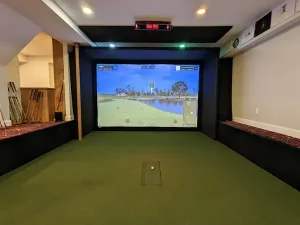
The space math for a simulator venue is unforgiving. You need a minimum of 10 feet of ceiling clearance, though 12 feet is strongly preferred to accommodate tall players and full-swing follow-through without restriction. Each bay requires approximately 200 to 300 square feet of hitting area, plus circulation space, lounge seating, a front desk, and restrooms. A four-bay venue needs a minimum of 3,500 usable square feet, and 4,500 to 5,000 is more comfortable.
Space Types That Work
Light-industrial flex space is the most common starting point. The ceiling heights are usually right, the base rent is lower than retail, and landlords are generally accustomed to tenants doing significant buildouts. Retail strip mall units work when parking is strong and visibility matters for walk-in traffic, but ceiling heights are often marginal and the rent premium can strain the model. Former warehouse or conversion spaces can work beautifully when ceiling heights are generous, but permitting for assembly occupancy often adds timeline and cost.
What to Negotiate in Your Lease
Before you sign anything, negotiate a buildout allowance. Landlords in markets with available commercial space will contribute between $15 and $40 per square foot toward tenant improvements in exchange for longer lease terms. This is not guaranteed money, but it is regularly available and can meaningfully reduce your upfront capital requirement.
Negotiate rent abatement for the buildout period. If your construction timeline is 60 to 90 days, you should not be paying full rent while the space is a construction zone. Three to four months of free or reduced rent during buildout is a standard ask and a reasonable one. Landlords know a tenant who opens strong is worth more than a tenant who opens broke.
Watch for exclusivity clauses, or the absence of them. If your landlord can lease adjacent space to a competing entertainment venue or another simulator operator, you want language that prevents it. It will not always be grantable, but it is always worth asking for.
The lease negotiation is where most first-time operators leave the most money on the table. A good buildout allowance and three months of rent abatement can fund your marketing budget and your first equipment deposit.
Yardstick Golf4. Equipment: Radar vs Photometric, and What Holds Up Commercially
This is the most technically consequential decision in the build, and it is the one most operators get wrong because they read consumer reviews instead of operator reviews. The launch monitor that earns five stars from a home user hitting 200 balls per week performs very differently from the unit absorbing 10 to 12 hours of daily commercial use, seven days a week.
There are two fundamentally different technologies, and they are not interchangeable.
Radar (Doppler) Systems
Radar-based systems like TrackMan use Doppler technology to track the ball and club from launch through flight. They mount overhead or at the side of the bay and require specific geometry relative to the hitting position, typically 8 to 12 feet of space in front of the ball and controlled mounting angles. They are relatively tolerant of variable lighting conditions, which makes them easier to work with in spaces where you can’t fully control the ambient environment.
The commercial case for radar: TrackMan in particular has significant brand recognition among serious golfers and instructors. If your target customer is the serious player who wants legitimate launch data, the TrackMan name carries weight that translates to bookings.
Photometric (Camera) Systems
Camera-based systems like the Foresight GCQuad and Uneekor QED use high-speed cameras to capture ball and club data at the moment of impact. They require tighter control over ambient lighting because the cameras are sensitive to inconsistent light, and they need a specific distance behind the ball for accurate capture, typically 18 to 24 inches. The ceiling height requirement is generally more forgiving than radar, making them viable in spaces where 10 feet is the maximum available height.
The commercial case for photometric: the software ecosystem is broader. GCQuad and Uneekor both integrate with GSPro, E6 Connect, and TGC2019, giving operators more flexibility in the simulation experience they offer. Photometric units also tend to have lower entry-level price points, which matters when you’re equipping four or six bays simultaneously.
| Factor | Radar (e.g., TrackMan) | Photometric (e.g., GCQuad, Uneekor) |
|---|---|---|
| Room depth required (in front of ball) | 8–12 ft | 2–3 ft (monitor sits close) |
| Minimum ceiling height | 12 ft preferred | 10 ft workable |
| Lighting sensitivity | Low | High (consistent lighting required) |
| Commercial hardware cost per bay | $20,000–$30,000+ | $12,000–$25,000 |
| Software ecosystem flexibility | TrackMan software only | GSPro, E6, TGC2019, others |
| Brand recognition with serious golfers | Very high | High (Foresight), moderate (others) |
| Maintenance under commercial daily use | High durability | High (lens cleaning protocol required) |
What Breaks, and When
The launch monitor itself is rarely the first thing to fail under commercial use. Impact screens take the most abuse, typically lasting 18 to 36 months before needing replacement at $500 to $2,500 per screen depending on size and quality. Hitting mats wear out faster than most operators expect, often within 12 to 18 months under heavy daily use. Budget for both as recurring annual costs, not one-time capital expenses.
Projectors are the piece most operators underspec. A consumer-grade projector rated for 3,000 hours of lamp life will not survive a commercial environment. Commercial-rated projectors with replaceable lamps or laser light sources are the right call, even at a higher upfront cost.
Before you purchase any commercial simulator hardware, confirm: What are the software licensing terms for commercial venues? What is the warranty for commercial as opposed to residential use? What is the vendor’s average response time when a system fails mid-booking? A cheap unit that goes down on a Saturday afternoon and takes 72 hours to get a technician is not cheap.
5. Golf Simulator Business Permits, Licenses, and Insurance
This section is where the aspiration meets the regulatory reality. None of it is complicated, but all of it has a timeline, and operators who underestimate that timeline push their opening dates back by weeks or months.
The Pre-Opening Checklist
Business entity formation comes first. An LLC or S-Corp protects your personal assets from business liability claims. Register with your state, obtain an EIN, and open a dedicated business bank account before you start spending on buildout. This takes one to two weeks and costs a few hundred dollars.
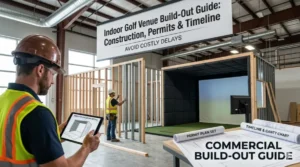
Building permits and a certificate of occupancy are required for any construction work and for operating as an assembly space. The timeline varies significantly by jurisdiction, from three weeks in some markets to three months in others. Get this process started the day you sign your lease.
A liquor license, if you plan to serve alcohol, requires the longest lead time of any pre-opening requirement. Depending on your state and municipality, the process can take 30 to 120 days. Apply the day you know your address. The F&B revenue line is too important to your overall model to delay it by starting the license application late.
Insurance: Not Optional, and Not Generic
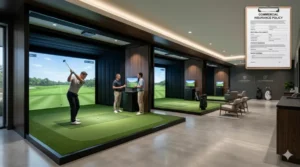
Golf simulator venues need coverage that standard commercial policies often don’t provide. A general business owner’s policy (BOP) may not cover recreational activity liability, may exclude equipment breakdown from internal failure, and may not include the business interruption coverage that protects you when a projector failure or screen damage takes a bay offline for a week. Learn more about what golf simulator business insurance covers and what it costs.
There are six coverage categories every simulator venue should evaluate before opening.
General liability is the floor. Most commercial landlords require a minimum of $1 million in general liability coverage before they will execute a lease. This is not a negotiation, it is a condition. Budget $800 to $2,500 per year for a standalone venue. Purpose-built programs like the one available through golfsimulatorinsurance.com/yardstick/ start at $803 annually and quote and bind fully online, which means you can have a certificate of insurance in your hands the same day you need it for a lease signing.
Commercial property coverage protects your physical equipment, screens, furniture, and buildout improvements from fire, theft, and water damage. This is especially important for venues in multi-tenant buildings where a fire or water event in an adjacent unit can damage your equipment without any negligence on your part.
Equipment breakdown coverage is the one operators most frequently skip and most regret skipping. It covers the failure of electronic and mechanical equipment from internal causes, including a launch monitor that fails outside its warranty period or a projector lamp that dies during peak season. A TrackMan I/O costs more than $25,000. Standard property insurance does not cover mechanical breakdown.
Business interruption coverage protects your revenue stream while repairs are underway. If a bay is down for a week because of screen damage, you are not just paying for the repair, you are losing the bookings that would have filled that bay. Business interruption covers that lost income up to your policy limits.
Workers compensation is required in most states once you have employees. Add liquor liability to the stack if you serve alcohol. Budget $3,000 to $8,000 annually for a complete coverage package at a mid-size venue.
Nearly every commercial landlord will require a certificate of insurance naming them as an additional insured before you take possession of a space. Get your general liability policy in place before lease negotiations conclude, not after. A purpose-built program like Golf Simulator Insurance is built specifically for this venue type, quotes online in minutes, and can issue your certificate the same day.
Waivers: What They Cover and What They Don’t
A signed liability waiver reduces your exposure but does not eliminate it. Courts in many states will allow waiver challenges when there is evidence of gross negligence, inadequate safety instruction, or a minor signer. Your waiver is a meaningful layer of protection, but it is not a substitute for general liability insurance. Run both.
6. How to Price Your Bays, Memberships, and Events
Pricing is where the financial model either holds together or starts leaking. The most common mistake is setting bay rental rates based on what seems fair and building the membership program as an afterthought. The operators who build the most predictable revenue structures do it in reverse: they design the membership program first, then set walk-in rates to make memberships look like the obviously better value.
Bay Rental Rates
Walk-in bay rental typically runs between $40 and $80 per hour depending on market, facility quality, and time of day. Peak hours (evenings and weekends) support the top end of that range. Off-peak daytime hours during the week often benefit from dynamic pricing that fills otherwise empty bays at a lower rate rather than letting that capacity go dark.
Price per bay, not per person. Charging per player creates friction and incentivizes smaller groups. A foursome paying $60 per hour per bay will book more freely than the same foursome trying to calculate whether to bring a fourth player at $15 per person per hour.
Memberships
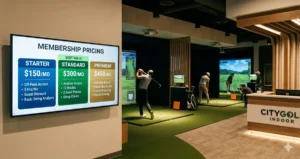
Memberships are the financial engine of a sustainable simulator business. Monthly recurring revenue from members covers a predictable percentage of your fixed costs, reduces your dependence on daily walk-in volume, and creates a customer base you can market to directly. The industry benchmark is $99 to $299 per month, but the right price for your venue depends on what access you include at each tier.
| Tier | Typical Price Range | What to Include | Best For |
|---|---|---|---|
| Social | $79–$119/mo | 4–6 hrs bay time, booking priority | Casual players, price-sensitive markets |
| Core | $149–$199/mo | 10–12 hrs, 10–15% F&B discount, event priority | Most markets. This is your volume tier. |
| Premium | $249–$349/mo | Unlimited off-peak, guest passes, lesson credits | High-income markets, serious players |
| Corporate | $500–$1,200/mo | 2–4 seats, flexible hours, event access | Any market with a corporate corridor |
Corporate Events and Group Bookings
Corporate events are the highest-margin revenue line in the business. A group of 20 booking a three-hour private event can generate $1,200 to $2,500 in a single booking, plus food and beverage. Package these deliberately. A “Corporate Golf Night” package with reserved bays, a dedicated staff member, and catering coordination requires almost no additional capacity, just clear pricing and a booking path that does not require a phone call.
Price corporate packages as flat-rate buyouts rather than per-person or per-hour calculations. It is easier to sell, easier to manage, and easier to upsell with add-ons like club fitting, lessons, or custom league formats.
7. Marketing Before You Open
The pre-opening period is the highest-leverage marketing window you will ever have. Curiosity is at its peak, the story is new, and people want to be part of something before it opens. Operators who capitalize on this window with a structured pre-opening membership campaign often cover their first two months of fixed costs before they pour a single drink or flip on a single projector.
The Membership Pre-Sale
Launch a founding member campaign three to six weeks before your target opening date. Offer a limited number of memberships at a discounted rate for founding members who commit before the doors open. The discount signals that early commitment has value. The cap signals scarcity. Together they drive urgency that generic “coming soon” messaging never creates.
A founding member campaign that converts 30 to 50 memberships at an average of $150 per month generates $4,500 to $7,500 in monthly recurring revenue from the first day you open. That number matters enormously when you’re navigating the first 90 days of operations.
Google Business Profile
Claim your Google Business Profile before you open. Set your category to Indoor Golf Center, upload photos of your build in progress (people are genuinely curious about what’s going in), and start collecting your opening date searches while you’re still a month out. Your GBP is the first thing someone sees when they search “indoor golf near me.” Getting it right before you open means you’re capturing that intent from day one rather than playing catch-up.
Local SEO Foundation
Publish at least three pieces of content before you open. An “About” page that covers your story and your equipment. A pricing and booking page. One substantive article, ideally something specific to your market like “Indoor Golf in [City]: What to Expect at [Venue Name].” These pages give Google something to index in the weeks before you open and give you a foundation to build on as your domain earns authority.
The venues that open with a membership waitlist are playing a different game than the ones that open with a ribbon-cutting and hope the walk-ins show up. The pre-sale isn’t a promotional tactic, it’s a financial stress test. If you can’t sell 20 memberships before you open, you need to ask hard questions about your pricing or your market.
Yardstick GolfLeagues as a Retention Engine
League programs are underutilized by most operators, particularly in the first year when filling midweek daytime hours is the biggest operational challenge. A Tuesday-night corporate league of eight teams with a 10-week season fills eight bays every Tuesday evening, generates consistent F&B revenue from a team-focused crowd, and builds the community feel that keeps people from canceling their memberships. Set the format up to be self-managing with a leaderboard and weekly communication, and you’re adding revenue with minimal incremental labor.
8. Operations: Staffing, Booking Systems, and the First 90 Days
Opening is a validation event. The first 90 days of operations are where you find out whether your assumptions about staffing needs, booking patterns, and customer behavior were accurate. Most of them won’t be, and that’s not a failure, it’s information. The operators who treat the first 90 days as a calibration period rather than a full execution period make faster adjustments and come out of it with a business that actually fits their market.
Booking Systems
Choose your booking system before you open and make sure it handles everything your model requires from day one. The core requirements are multi-bay booking, online self-service, membership management, and payment processing. The additional requirements for more complex venues include F&B integration, event management, waiver collection, and dynamic pricing rules.
The most common operations mistake is launching with a booking system that works for walk-in hourly reservations but breaks down when a member wants to use their monthly hours against a booking, or when a corporate event requires a flat-rate buyout instead of a per-hour calculation. Fix this before your first booking, not after your first frustrated member.
Staffing Your Opening Weeks
Overstaff the opening period and adjust down as you understand the actual demand curve. A skeleton crew that cannot handle simultaneous check-ins, equipment questions, and walk-in inquiries on a busy Friday evening will damage your reputation in the critical first month. Reviews written in the first four weeks of a venue’s operation have outsized influence on your long-term Google rating. Staff for the busy scenario, not the average one.
Your front-of-house staff needs to understand the simulators well enough to troubleshoot basic issues and explain the technology to first-time users. A customer who books because they saw a TrackMan in the description and arrives to find the staff can’t explain the metrics will not rebook.
The Revenue Mix You’re Optimizing Toward
A healthy golf simulator business revenue mix at 12 months looks something like this: bay rentals at 50 to 60 percent of total revenue, memberships at 20 to 30 percent, F&B at 15 to 25 percent (for venues with a bar or food service), and corporate events and lessons at 10 to 20 percent. If your membership line is below 15 percent at 12 months, your membership program needs attention. If your F&B line is below 10 percent, your menu or service execution needs a look.
At the end of your first 90 days, pull four numbers: average revenue per bay per week, membership cancellation rate (churn), peak vs off-peak utilization split, and average booking lead time. These four metrics tell you more about the health of your business than any other data you will have at that stage. Membership churn above 5% per month is a product problem. Off-peak utilization below 30% is a pricing problem. Average lead time under 48 hours means you have demand you’re not capturing with advance booking incentives.
9. When to Add a Second Location
The operators who expand too early are usually driven by momentum rather than math. The ones who expand successfully have a clear signal from the business that the first location is operating on systems rather than on the founder’s daily presence.
There are four conditions that support a second location decision. Your first location is consistently running above 70 percent utilization during peak hours. Your membership base is stable with monthly churn below three percent. You have a general manager who runs the first location without you. And your first location is generating enough free cash flow to fund the deposit and working capital for a second.
If all four are true, a second location is a capital allocation question. If one is missing, fix the missing piece first. A second location does not fix a staffing problem or a retention problem at the first location. It amplifies both.
Franchise vs Independent Expansion
The golf simulator business franchise market is developing but not yet mature. There are franchise models available, and they bring operational playbooks, brand recognition, and purchasing power. What they cost is a franchise fee (typically $30,000 to $75,000) and ongoing royalties on revenue. For an operator who has already proven the model independently, the franchise trade may not make sense. For an operator who wants a proven system and brand support for their first location, it is worth a serious evaluation.
Starting a golf simulator business is not a passive income play. It is an operations business that rewards operators who make deliberate decisions in the right sequence: validate the market, model the finances honestly, negotiate the lease strategically, choose equipment that fits the space and the customer, get your legal and insurance stack in order before you need it, and build a membership base before you open the door. Do those things and the revenue per bay math works. Skip them and you are relying on enthusiasm to cover for planning gaps it can’t cover.
Similar Posts
Golf Simulator Business Marketing Strategies
Most golf simulator marketing advice reads like it was written in 2019 for a coffee shop. Set up a Facebook…
How to Choose the Right Location for an Indoor Golf Business
The right location can make an indoor golf business. The wrong one can drain it before the simulators are even…
Indoor Golf Sees a Sharp Rise in Popularity
The Golf Simulator Market in 2025: Trends, Growth, and Opportunities 4/7/2025 The golf simulator industry has seen remarkable growth…
Golf Simulator Business Insurance: Coverage & Costs
Most golf simulator operators carry a standard commercial general liability policy and consider the job done. The trouble is that…
Indoor Golf Venue Build-Out Guide: Construction, Permits & Timeline
Most golf simulator venue projects run 30 to 50 percent over original budget and open two to four months later…
Indoor Golf Membership Pricing: What to Charge and Why
Most indoor golf operators get membership pricing wrong in the same direction: too cheap to be sustainable, too complicated to…