A liquor license is one of the highest-ROI decisions you can make for a golf simulator venue. It can also be the one that blows your opening timeline if you treat it like an afterthought. Here is what the process actually costs, how long it actually takes, and what to have ready before you file. Our custom financial plan helps you get exactly the information you need to run the business you want.
- 01Why Alcohol Changes the Business Math
- 02Which License Type Does a Simulator Venue Need?
- 03Cost Breakdown by State
- 04How Long the Process Actually Takes
- 05The Application Process Step by Step
- 06The Five Things That Delay Every Application
- 07Insurance Your Landlord Will Actually Require
- 08Your Full Alcohol Compliance Budget
Why Alcohol Changes the Business Math
Most indoor golf venues run on bay revenue: hourly simulator time, leagues, maybe some merchandise. That model works, but it runs into a ceiling fast. The venues that consistently push revenue per square foot above that ceiling are the ones with a liquor license.
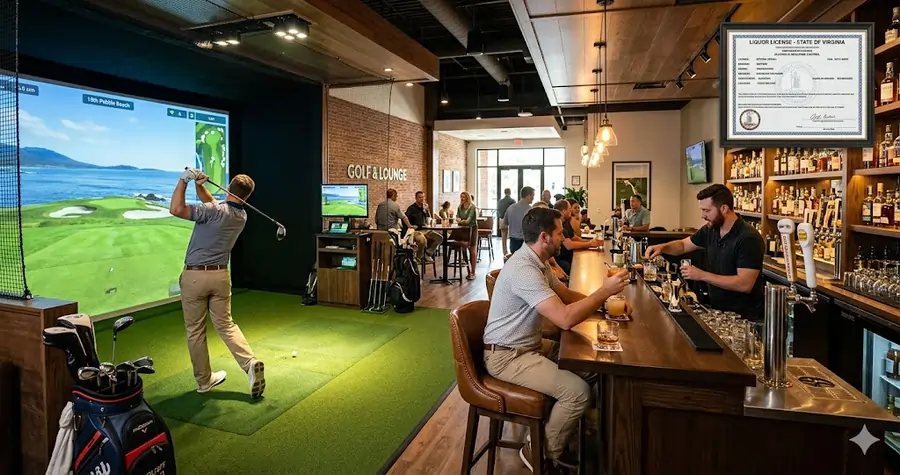
The reason is straightforward. A group that books two hours in a bay will usually stay for another round of drinks if the bar is right there. A corporate outing or bachelor party that might have been a two-hour booking becomes a four-hour event when alcohol is part of the package. F&B revenue on those evenings can rival or exceed the bay fees themselves.
There is also a positioning argument. Venues with a full bar attract the private event market, which is the most profitable booking category in the entire industry. No liquor license means no open bar packages, which means you are handing that segment to a competitor who has one.
None of this is a guarantee. Running a compliant, profitable bar inside a simulator venue requires real operational discipline. But the licensing cost and timeline, which intimidate a lot of first-time operators, are far more manageable than most people assume once you understand the process.
Which License Type Does a Simulator Venue Need?
The single most common mistake operators make is applying for the wrong license type. That mistake costs weeks and sometimes thousands of dollars in re-filing fees. Understanding the category that applies to an indoor golf and entertainment venue before you touch the paperwork saves both.
Golf simulator venues are entertainment venues with on-premise alcohol consumption. That puts them in the same general licensing bucket as restaurants and bars, but the specific license name and requirements vary by state. Here is how the main categories break down:
On-Premise Consumption License (Most Common)
This is the standard license for bars, restaurants, and entertainment venues where alcohol is consumed on the property. In most states, this is what an indoor golf venue needs. It authorizes the sale of beer, wine, and spirits for consumption at the venue. Some states require food service alongside it. Others do not. Check your state’s ABC board requirements on this point specifically, because the food requirement can affect your buildout plan.
Beer and Wine Only License
If you are not ready to run a full spirits program, a beer and wine license is a faster and cheaper path to opening with alcohol. The application process is typically less scrutinized, costs are lower in most states, and approval timelines are shorter. For a venue early in its life, this is a reasonable starting point. You can apply for a full spirits license as the operation matures.
Entertainment Venue License
A handful of states have created specific license categories for entertainment facilities, concert venues, and experience-based businesses. California’s Type 90 music venue license is one example. These licenses are not always a fit for golf simulator businesses, depending on how your state defines the category, but they are worth reviewing with a local licensing attorney if your state offers them.
Some states are “control states” where the government manages wholesale distribution of spirits. Pennsylvania, Virginia, and Utah are examples. Operating a bar in a control state involves an additional layer of procurement and compliance beyond the license itself. If you are in a control state, factor that into your planning before your build-out, not after.
The bottom line on license type: call your state’s Alcoholic Beverage Control board directly before you apply. Give them your business model, your address, and your intended service model. They will tell you exactly which license category applies. That call takes 20 minutes and can save you months of delays.
Cost Breakdown by State
License fees vary by an order of magnitude depending on where you are opening. A straightforward beer and wine license in a mid-sized Midwest market and a full spirits license in New York City are not the same conversation. Here is a practical breakdown of what operators in major markets are actually paying.
| State / Market | License Type | State Application Fee | All-In Estimate | Timeline |
|---|---|---|---|---|
| New York (NYC) | On-Premise Full Liquor | $4,552 | $12,000 – $18,000 | 6 – 10 months |
| New York (Upstate / LI) | On-Premise Full Liquor | $1,992 | $3,000 – $6,000 | 60 – 90 days |
| California (LA) | Type 47 On-Sale General | $945 (non-priority) | $140,000 – $170,000 | 12 – 18 months |
| California (Other Counties) | Type 47 On-Sale General | $945 | $5,000 – $25,000 | 6 – 12 months |
| Texas | Mixed Beverage Permit | Varies by county population | $2,000 – $7,500 | 60 – 90 days |
| Illinois | On-Premise Consumption | $750 – $2,500 | $2,000 – $5,000 | 60 – 120 days |
| Florida | 4COP (Full Liquor, Food) | Quota-based; secondary market varies | $5,000 – $40,000+ | 90 – 180 days |
| Most Other States | On-Premise Beer/Wine or Full | $300 – $3,000 | $1,500 – $8,000 | 45 – 120 days |
Costs sourced from liquorlicensecost.com and posnation.com. State fees and timelines vary — confirm current figures with your state ABC board.
Los Angeles County has not issued new Type 47 full liquor licenses in years. The secondary market for existing licenses runs $140,000 to $170,000 and is still climbing. If you are opening in LA County and need full spirits, work with a specialized licensing attorney before you sign a lease. Beer and wine (Type 41) remains available as a new license and is the faster, cheaper path for most simulator venues in that market. Cost data via ggslicensing.com.
The Real All-In Number
The state application fee is only part of the cost. Once you add up the supporting expenses, the number grows. Here is what goes into a realistic all-in figure for most markets:
Attorney fees run $500 to $5,000+ depending on state complexity and whether your application hits any complications. Background check and fingerprinting fees are typically $75 to $200 per principal. Public notice publication, where required, costs $100 to $500. Local municipal fees, separate from the state fee, add another $100 to $1,000 in many jurisdictions. If your state requires a zoning variance or conditional use permit for alcohol service in your location, budget an additional $1,500 to $5,000 and 30 to 90 days of extra lead time.
The national average cost for a standard on-premise alcohol license, excluding secondary market purchases, runs between $1,000 and $3,000 in state fees alone. Total all-in cost across most markets lands between $2,000 and $10,000 for a new venue without secondary market complications. Budget $1,500 as an absolute floor and plan for more.
How Long the Process Actually Takes
This is the part that catches most first-time operators off guard. The application process is not the slow part. The slow part is everything that happens before you can file.
On average, operators should plan for three to six months from the decision to pursue a license to the day they can legally serve. In complex markets or applications with any hiccups, six to twelve months is realistic. A handful of states with streamlined online systems can move a clean application through in four to six weeks. Those are the exception.
New York’s State Liquor Authority currently takes 22 to 26 weeks for standard applications. California’s ABC can take six months to a year in many counties. Texas and Illinois typically run 60 to 90 days for a complete, uncontested application. The range is wide, and the difference between fast and slow is usually how early you start and how complete your application is at submission.
The Hidden Timeline Problem
Many operators do not realize that the clock does not start when you file with the state. In New York, for example, you must notify your local municipality at least 30 days before filing with the SLA. That notification period is required, and it does not count toward your SLA review time. Operators who skip this step or do not know about it effectively lose a month before the state even looks at their application.
Most states also require a public notice posting period, typically two to six weeks, during which community members can raise objections. If objections come in, expect a public hearing and an additional 30 to 45 days on the timeline. Strong community opposition in a contested hearing can push the entire process past six months even in states with otherwise reasonable timelines.
Several states offer temporary or interim permits that allow alcohol service while a full application is under review. New York’s temporary retail permit is processed in approximately 30 days and is valid for 180 days with extension options. If you are opening in a state that offers this, apply for the temporary permit the moment your full application is submitted. It can be the difference between opening with a bar and opening without one.
The Application Process Step by Step
The process varies by state, but the core sequence is consistent across most jurisdictions. Here is what to expect and when to start each step relative to your target opening date.
Step 1: Determine Your License Type (6+ Months Out)
Before anything else, confirm the right license category for your business model with your state’s ABC board. Full spirits, beer and wine, or entertainment venue license, each has different requirements, fees, and timelines. Get this right before you touch any forms.
Step 2: Confirm Zoning Clearance (5-6 Months Out)
Check with your local planning or zoning office that your location is zoned for on-premise alcohol sales. Also confirm distance requirements from schools, churches, and other licensed premises. In many jurisdictions, a location that fails the distance test cannot receive a license regardless of your application quality. Confirm this before you sign a lease.
Step 3: Gather Required Documents (4-5 Months Out)
Most states require a combination of the following: completed state application forms, business formation documents and operating agreement, lease or property ownership documents, floor plan and site plan showing the licensed premises, financial disclosures for all principals, background check authorization and fingerprinting for all principals with 10%+ ownership, and federal Employer Identification Number.
Step 4: Notify Local Municipality (4 Months Out)
In states that require it, notify your local government before filing the state application. This step is easy to miss and expensive to skip. The notification period does not count toward your state review timeline. Start it as early as your state allows.
Step 5: Submit and Post Public Notice (3-4 Months Out)
File the complete application with your state’s ABC board and pay the application fee. Post the required public notice at your location or in a local publication as your state requires. The notice period, typically two to six weeks, runs concurrently with early application processing in most states.
Step 6: Inspections and Background Checks (2-3 Months Out)
Expect a visit from a licensing officer or inspector. Health, fire, and building code inspections may also be required, depending on your state. Background checks for all named principals run during this phase. Do not have anything in your application that conflicts with your business registration, lease, or financial disclosures, because investigators cross-reference everything.
Step 7: Final Approval (4-6 Weeks Out)
After all checks clear and the public notice period closes without objection, the application moves to final review. Approval is issued and the license is mailed or available for pickup. Display it prominently at your venue per your state’s requirements.
The Five Things That Delay Every Application
Most delays are preventable. These are the recurring patterns that push timelines from 90 days to 180 days across every market.
1. Incomplete Applications
Missing a signature, a document, or a form field is the most common delay. ABC boards return incomplete applications and restart the review clock. Go through the checklist twice before submission and have your attorney review the package if you are in a complex market.
2. Zoning Problems Discovered After Lease Signing
Signing a lease before confirming alcohol zoning clearance is one of the most expensive mistakes in this business. If the location cannot receive a license, you are either stuck with a venue that cannot serve alcohol or paying to break a lease. Confirm zoning before you sign.
3. Community Objections
Neighbors, nearby schools, or existing businesses can file formal objections during the public notice period. Each objection typically triggers a hearing. If you are opening in a dense residential area or near other licensed establishments, do your homework before you file. Meeting with neighboring businesses and property owners before the public notice period can neutralize objections before they are filed.
4. Background Check Issues
Any criminal history, outstanding judgments, or inconsistencies between the application and public records adds weeks to the review. If any principal on the application has anything in their history, discuss it with a licensing attorney before you file. Full, proactive disclosure handled correctly is better than a surprise during the investigation.
5. Not Starting the Local Notification First
Covered above, but worth repeating because it catches so many operators: if your state requires local notification before the state filing, start that process the moment you have a confirmed location and license type. Every day you wait is a day added to your opening date.
Insurance Your Landlord Will Actually Require
Every landlord who leases space to a venue serving alcohol will require proof of insurance before you open. This is not optional. The Certificate of Insurance (COI) is what your landlord will ask for at lease signing and at every renewal, and the coverage requirements for a venue with a liquor license are different from a standard retail tenant.
The coverage categories that matter most for a golf simulator venue with alcohol service are general liability, liquor liability (also called dram shop coverage), property insurance for your equipment, and workers’ compensation. Of these, liquor liability is the one most operators underestimate. A single alcohol-related incident at your venue, whether a guest drives home impaired or an injury occurs on-premises after drinking, can generate a claim that a general liability policy alone will not fully cover.
Get a Certificate of Insurance Built for Simulator Venues
Golf Simulator Insurance, offered through our partner CoverMyNiche, is a specialty program designed specifically for indoor golf venues. General liability, liquor liability, equipment coverage, and the COI your landlord requires. One application, built for this industry.
Get Coverage DetailsThe Golf Simulator Insurance Program is offered through CoverMyNiche, LLC, a licensed insurance wholesaler. Yardstick Golf is a marketing partner and is not a licensed insurance producer.
Dram shop laws, which hold venues liable for harm caused by visibly intoxicated patrons, exist in most states. The liability exposure is real and the cost of an uninsured or underinsured claim is the kind of thing that ends businesses. Liquor liability coverage is not an add-on to figure out later. It goes into your pre-opening budget alongside the license application fees.
On the startup cost side, the full insurance package for a golf simulator venue with alcohol service typically runs $3,000 to $8,000 annually. That estimate covers general liability ($1M to $2M), equipment coverage for your simulators, and liquor liability. The exact number depends on your state, your revenue projections, and the number of bays you are operating.
For more on the full insurance picture for a simulator venue, including what your landlord’s COI requirements will look like before you open, see our in-depth guide to golf simulator business insurance.
Most commercial landlords require a COI naming them as an additional insured before they hand over keys. If you are applying for a liquor license and your lease is tied to a specific opening date, get your insurance application running in parallel with your license application. The two processes are independent of each other but the outputs are both required before you open.
Your Full Alcohol Compliance Budget
Pulling all of this together into a single pre-opening budget line is how you avoid surprises. Here is how the numbers stack up for a typical multi-bay indoor golf venue in a mid-market location, outside of high-cost states like California and New York.
| Cost Item | Typical Range | Notes |
|---|---|---|
| State liquor license application fee | $500 – $3,000 | Varies by state and license type |
| Local municipal permit | $100 – $1,000 | Separate from state fee in many jurisdictions |
| Attorney fees | $500 – $3,000 | Higher in complex markets or contested applications |
| Background checks and fingerprinting | $100 – $400 | Per principal with 10%+ ownership |
| Public notice publication | $100 – $500 | Where required by state law |
| Zoning / conditional use permit | $0 – $5,000 | Only required if zoning variance is needed |
| General liability insurance (annual) | $1,500 – $3,500 | $1M to $2M coverage typical for simulator venues |
| Liquor liability insurance (annual) | $800 – $2,500 | Required by most landlords; covers dram shop exposure |
| Equipment / property coverage (annual) | $500 – $2,000 | Covers simulator hardware and build-out |
| Total Pre-Opening (Mid-Market) | $4,000 – $15,000 | Excluding high-cost state premiums and secondary market licenses |
The numbers in high-cost states, particularly California’s major metros and New York City, are in a different category. Los Angeles operators who need a full spirits license on the secondary market should budget $140,000 to $170,000 for the license alone. New York City operators pursuing a full on-premise license all-in should plan for $12,000 to $18,000. In those markets, the liquor license is a significant capital decision, not an administrative cost.
For a full picture of what starting an indoor golf business costs across all line items, from simulator hardware to build-out and staffing, the Yardstick Golf startup cost guide breaks it down by venue size and market type.
See the Revenue and Cost Numbers From Real Venues
The Yardstick Golf Indoor Golf Business Study compiles financial benchmarks from operators across the country, including venues with and without alcohol programs. If you are building a business plan or pro forma, it is the best industry-specific data available.
Get the Business StudyThe liquor license is worth getting. The revenue upside from private events, extended bay sessions, and F&B margin is significant enough that most operators with a bar consistently outperform those without one. The process is slower and more expensive than most first-timers expect, but it is also very manageable if you start early and hire an attorney for anything beyond the simplest markets. Start the application six months before your target opening date, confirm your zoning before you sign a lease, build liquor liability into your insurance program from day one, and factor the full compliance budget into your startup pro forma before you commit to a space.
Read more about starting a golf simulator business.
The Golf Simulator Insurance Program is offered through CoverMyNiche, LLC, a licensed insurance wholesaler. Neither Yardstick Golf nor [Sub-Partner] is a licensed insurance producer, and neither is authorized to sell, solicit, or bind insurance. I/we may receive a referral fee if you purchase coverage through this link.