Golf cart batteries are not one-size-fits-all, and guessing wrong is an expensive way to find that out. Get the voltage mismatched to your cart or your use case and you either leave power on the table or drop money on capacity you’ll never touch. Here’s what actually separates 6 volt, 8 volt, and 12 volt setups, and which one belongs in your cart.
Battery Chemistry: What You’re Actually Buying
Before you land on a voltage, you need to know what’s inside the case. Every golf cart battery on the market falls into one of four chemistries, and the differences matter more than the marketing copy suggests.
- Flooded lead-acid (wet cell): The default in most golf carts, on and off the course. Reliable, well understood, and the most affordable option per unit of capacity. The tradeoff is maintenance: you’re checking water levels and topping them off if you want the battery to hit its rated life.
- AGM and gel lead-acid: Sealed, so no watering. That convenience comes at a real cost premium without a corresponding jump in power output or charge time, which is exactly why you see fewer AGM and gel batteries in commercial golf cart fleets.
- Lithium iron phosphate (LiFePO4): The newest entrant and the one showing up standard in modern carts from EZ-GO and Club Car. Zero watering, faster recharge, and meaningfully lighter than a lead-acid equivalent. You pay for that upfront, but the manufacturer cycle-life claims run well ahead of flooded lead-acid.
Check your cart’s factory charger before switching chemistries. A charger built for flooded lead-acid won’t always deliver the correct charge profile for lithium, and using the wrong charger is the fastest way to shorten a battery’s life regardless of how good the battery is.
6 Volt Golf Cart Batteries: Best Picks and When They Win
Six-volt batteries are the standard in older and factory-original golf cart battery banks, and they’re still the most budget-efficient way to get reliable deep-cycle power. If your cart was built around a 6V configuration, staying there is usually the right call rather than an upgrade project.
- Longer effective lifespan than a comparable 12V unit when maintained on a normal watering schedule.
- Deep cycling built for the job. These are designed to discharge and recharge repeatedly without the performance drop-off you’d see from a battery not rated for cyclic use.
- Lower cost per battery than 8V or 12V options, which matters when you’re replacing a full bank of four to six batteries at once.
- Factory compatibility. Many older carts were engineered around 6V banks specifically, so sticking with the original voltage avoids wiring and charger complications.
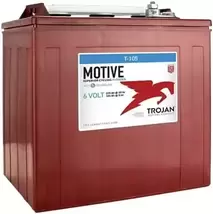
Trojan T-105 6V Flooded Battery
The industry benchmark for a reason. The T-105 shows up in golf carts, RVs, and off-grid solar banks because it delivers consistent output under heavy daily use and holds up well over time when the water levels get proper attention.
- Capacity: 225 Ah (20-hour rate)
- Cycle life: Approximately 750 cycles at 50% depth of discharge
- Weight: 62 lbs
- Warranty: 18 months
Pros: High capacity, durable construction, long cycle life, widely available for replacement.
Cons: Requires regular watering, heavier than sealed alternatives.
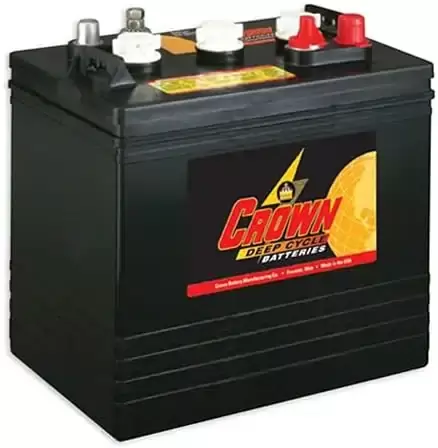
Crown CR-220 6V Golf Cart Battery
Built for the same heavy-duty use case as the T-105, with a slightly higher rated cycle life. A solid pick if you want Trojan-level durability from a different manufacturer for pricing or availability reasons.
- Capacity: 220 Ah (20-hour rate)
- Cycle life: Approximately 800 cycles at 50% depth of discharge
- Weight: 62 lbs
Pros: High capacity, reinforced casing, strong cycle life rating.
Cons: Requires regular watering, larger footprint may need space planning in tighter battery trays.
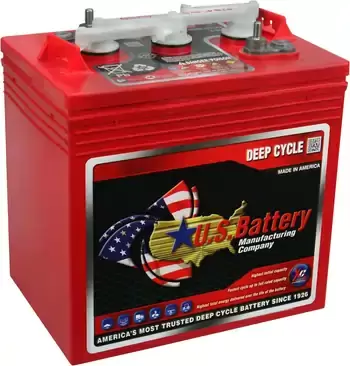
US Battery US2200 XC2 6V Battery
US Battery’s proprietary XC2 plate formulation is the differentiator here, aimed at improving plate efficiency and energy density over a standard flooded design.
- Capacity: 232 Ah (20-hour rate)
- Cycle life: Designed for extended cycle life with proper maintenance (manufacturer rating, not numerically specified)
- Weight: 62 lbs
Pros: Highest capacity of the three in this category, proprietary plate technology for efficiency.
Cons: Requires regular watering and terminal cleaning.
| Battery | Capacity | Cycle Life (50% DOD) | Weight |
|---|---|---|---|
| Trojan T-105 | 225 Ah | ~750 cycles | 62 lbs |
| Crown CR-220 | 220 Ah | ~800 cycles | 62 lbs |
| US Battery US2200 XC2 | 232 Ah | Extended (not numerically rated) | 62 lbs |
8 Volt Golf Cart Batteries: Best Picks and When They Win
Eight-volt batteries sit in the middle of the lineup, a practical compromise between the affordability of 6V and the punch of 12V. They handle deep cycling well and tend to strike a better power-to-weight balance than either end of the spectrum.
- Balanced power and weight. You get more per-battery capacity than 6V without the full jump to 12V hardware.
- Deep cycle handling built to support multiple rounds or shifts without a steep performance drop.
- Cost-effective relative to larger voltage options, particularly for fleets replacing several battery banks at once.
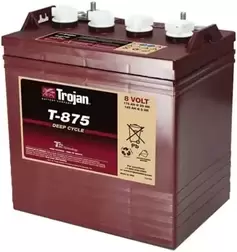
Trojan T-875 8V Golf Cart Battery
Trojan’s 8V entry carries the same reputation for capacity and longevity as the T-105, backed by a shorter but still solid warranty window.
- Warranty: 12 months
Pros: Trusted brand, strong capacity for the voltage class.
Cons: Shorter warranty than the 6V T-105, still requires flooded-battery maintenance.
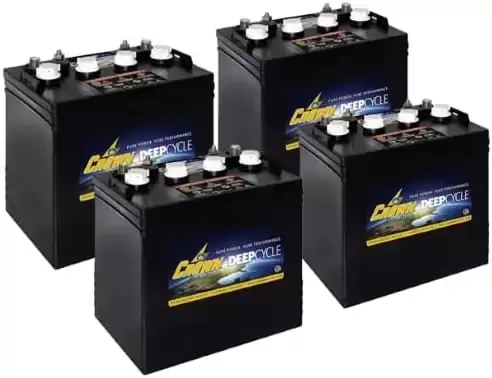
Crown CR-165 Deep Cycle Battery
A dependable middle-tier option from a manufacturer known for durability. Good fit if you want Crown’s build quality without stepping up to their higher-capacity 6V or 12V lines.
Pros: Reliable brand reputation, solid deep-cycle performance.
Cons: Standard flooded-battery maintenance applies.
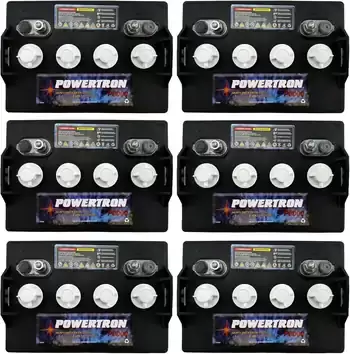
Powertron 8V Golf Cart Battery
Less of a household name than Trojan or Crown, but built on the same rugged lead-acid cell construction. A reasonable option if either of the top two brands is out of stock or priced above your budget.
Pros: Rugged construction, consistent sustained power delivery.
Cons: Less established track record and resale/replacement availability than Trojan or Crown.
12 Volt Golf Cart Batteries: Best Picks and When They Win
Twelve-volt is where the decision gets interesting, because it’s the voltage class where lithium enters the conversation. If you’re climbing hills regularly, running a commercial fleet, or just done with watering batteries every few weeks, this is the tier to look at.
- More power, longer run times. Better suited to demanding terrain or extended daily use than a 6V or 8V bank.
- Higher efficiency, less upkeep, especially with lithium chemistry in the mix.
- Stronger acceleration from higher energy density, noticeable on hilly courses or heavier carts.
- Higher upfront cost, which is the real tradeoff against the 6V and 8V categories.
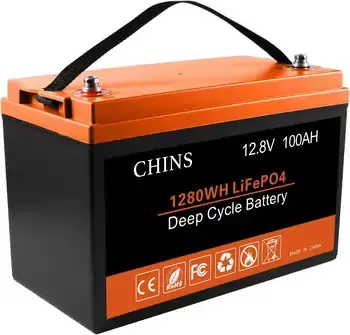
LiFePO4 12V 100Ah Lithium Battery
The maintenance-free option. Significantly lighter than a lead-acid 12V of similar output, with a faster recharge cycle and a cycle-life rating the manufacturer puts at roughly double a comparable lead-acid battery.
- Capacity: 100 Ah
Pros: Zero maintenance, lightweight, rapid recharge, long manufacturer-rated cycle life.
Cons: Highest upfront cost in this guide, requires a lithium-compatible charger.
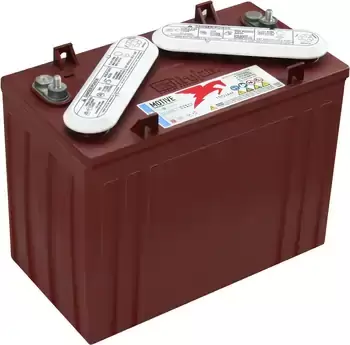
Trojan T1275 12V Deep Cycle Battery
Trojan’s proprietary Alpha Plus Paste formula is built into this 150Ah unit, aimed at extending life and durability under the higher discharge demands a 12V bank sees.
- Capacity: 150 Ah
Pros: High capacity for multi-round use, proprietary paste formula for extended durability.
Cons: Flooded lead-acid, so watering and ventilation requirements still apply.
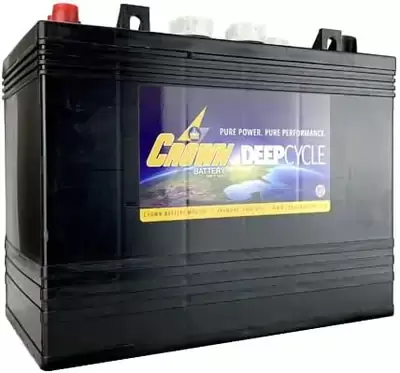
Crown T-1275 12V Deep Cycle Battery
A workhorse built with thick plates and reinforced internal components, matched to the Trojan T1275 on capacity for buyers who want a second-brand option at this voltage.
- Capacity: 150 Ah
Pros: High capacity, durable plate construction, strong runtime for serious daily use.
Cons: Not maintenance-free, heavier than the lithium alternative.
Voltage Comparison at a Glance
| Voltage | Best For | Maintenance | Cost Position |
|---|---|---|---|
| 6 Volt | Older/factory-original carts, budget-conscious replacement | Watering required (flooded) | Most affordable of the three |
| 8 Volt | A power step-up without a full 12V commitment | Watering required (flooded) | Mid-range |
| 12 Volt | Hilly terrain, heavy daily use, or maintenance-free lithium | Watering required (lead-acid) or none (lithium) | Highest upfront, especially lithium |
How to Choose: 6 Factors That Matter
Battery Capacity
Measured in amp-hours (Ah), capacity determines how much energy the battery can store and deliver. Long rounds or extended daily use call for higher Ah ratings, full stop.
Run Time
How long the battery powers your cart before it needs a recharge. If disruptions mid-round are a dealbreaker, prioritize batteries with longer rated run times over ones that are simply cheaper.
Cycle Life
The number of charge and discharge cycles a battery can handle before performance starts to fall off. Higher cycle life ratings mean fewer replacements over the life of your cart, which is where the sticker price gets recovered.
Maintenance Requirements
Flooded lead-acid needs regular watering and terminal cleaning. Lithium needs none. Be honest with yourself about whether you’ll actually keep up with a watering schedule before buying flooded.
Brand Reputation
Trojan, Crown, and US Battery show up repeatedly in this guide for a reason: consistent quality and wide replacement availability. Read current owner reviews before buying from a less established brand.
Price
Stick to your budget, but weigh sticker price against cycle life and warranty. A battery that costs more but lasts twice as many cycles is often the cheaper option per year of service.
If your cart came factory-equipped for 6 volt and you want the lowest all-in cost, stay there. The Trojan T-105, Crown CR-220, and US Battery US2200 XC2 all deliver dependable deep-cycle performance for that use case.
Stepping up to 8 volt makes sense as a middle-ground upgrade when you want more power without a full rewiring project.
Going 12 volt is the right call for hilly terrain, heavy daily use, or fleet operations, and it’s the tier where lithium is worth serious consideration if you want to stop watering batteries altogether and can absorb the higher upfront cost.
This site participates in the Amazon Services LLC Associates Program, an affiliate advertising program. Some links on this page are affiliate links, meaning we may earn a commission on qualifying purchases at no additional cost to you.