
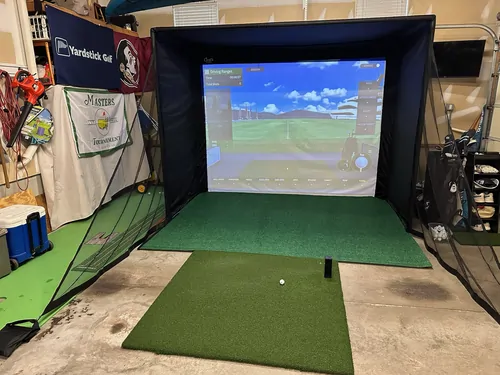
The enclosure is what makes a golf simulator safe to swing a driver in. It catches shanks, stops bounceback and frames the image. We have used all seven enclosures below, from a $1,000 DIY pipe kit in a working garage to fully retractable and commercial-grade bays, and each one is best for a different kind of space.
Start with your room. A fixed enclosure gives the best protection and picture for a dedicated room. A retractable one lets a garage or family room go back to normal use. And the impact screen inside the enclosure matters as much as the frame, so we cover the best screens too.
Reid Colson and the Yardstick Golf team have used every enclosure in this guide, and Reid built his own garage simulator around the Carl’s Place DIY kit. We looked at setup time and difficulty, bounceback, noise, shank protection, screen tension and image quality, and how much room each one takes. Prices were checked at each retailer between September 30 and October 5, 2026. See how we rate golf gear.
Best golf simulator enclosures: quick comparison
| Enclosure | Best for | Frame | Setup | Price |
|---|---|---|---|---|
| SIG10 | Standard 10-foot rooms | Push-pin steel | Low | $1,999.99 |
| SIG Professional (SIG12) | Premium look, easy setup | Push-button steel | Low, solo build | $2,499.99 |
| Carl’s Place Pro | Dedicated sim rooms | 2-inch EMT | High, 2+ people | From $3,409.95 |
| Carl’s Place DIY | Budget builds | 1-inch EMT (buy locally) | Moderate | From $999.95 |
| PlayBetter SimStudio | All-in-one package | Tool-free metal | Low to moderate | $2,195 (BYO) |
| SportScreen Vanish | Retractable, full enclosure | Roller header | Moderate to high | $2,999.99 to $5,499.99 |
| G-Trak | Multi-use garages | Door-track or ceiling roller | Moderate | See retailer |
SIG10 Golf Simulator Enclosure (Shop Indoor Golf)
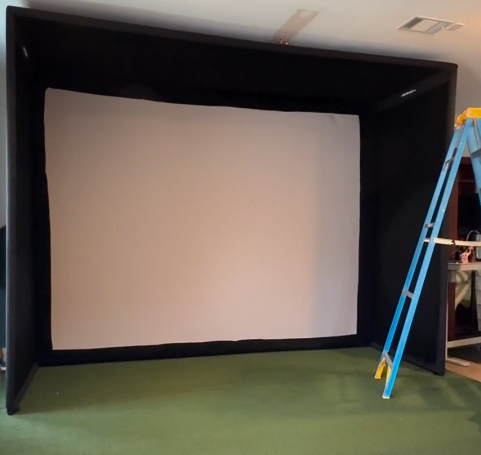
The SIG10 is the most common size target for residential spare rooms and one-car garage bays, and it is the enclosure we would point most home builders to first. The frame uses Shop Indoor Golf’s color-coded push-pin poles, so you snap it together instead of cutting and screwing pipe.
Two details stood out in use. A foam-padded bumper seals the bottom of the impact screen against your hitting mat or turf, which stops low, thin shots from skidding underneath. And the screen is tensioned with side straps as well as top and bottom bungees, which pulled out diagonal wrinkles faster than a standard grommeted screen.
Our take: Side extensions shield about 5 feet out from the screen, so shanks stay inside the bay. Plan for roughly 11 feet of total room width so you can assemble it without scraping the side walls.
Price: $1,999.99 at Shop Indoor Golf (checked Sep 30, 2026).
Frame: color-coded push-pin poles. Includes: foam padding for the frame, ball bungees, side barriers.
| Pros | Cons |
|---|---|
|
|
SIG Professional Series (SIG12)
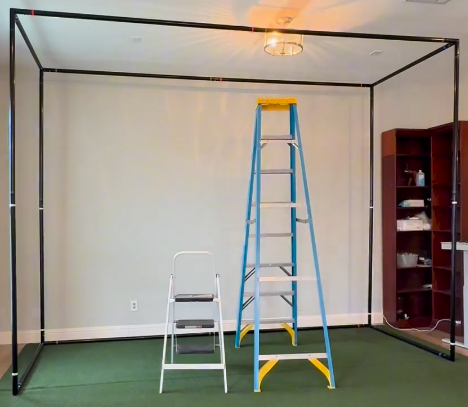
The SIG Professional series is built like a heavy-duty commercial bay: push-button, color-coded steel frame tubing, high-density foam padding, and a tight, clean surround fabric. The quick-connect buttons make setup far faster than screwing together EMT conduit.
The side surrounds clip directly to the frame and hold their tension without sagging, which gives the whole bay a flush, built-in look. The foam surrounds border the screen perimeter, so wedge shots and high mishits don’t slap the frame.
Our take: Most DIY setups fight bounceback by trial and error. The SIG’s dual-layer impact screen and bungee system got it right out of the box: full driver swings dropped straight to the turf instead of rebounding back toward our stance.
Price: $2,499.99 for the SIG12 at Shop Indoor Golf (checked Sep 30, 2026).
Frame: push-button color-coded steel. Sizes: fixed (SIG8, SIG10, SIG12).
| Pros | Cons |
|---|---|
|
|
Carl’s Place Pro Enclosure
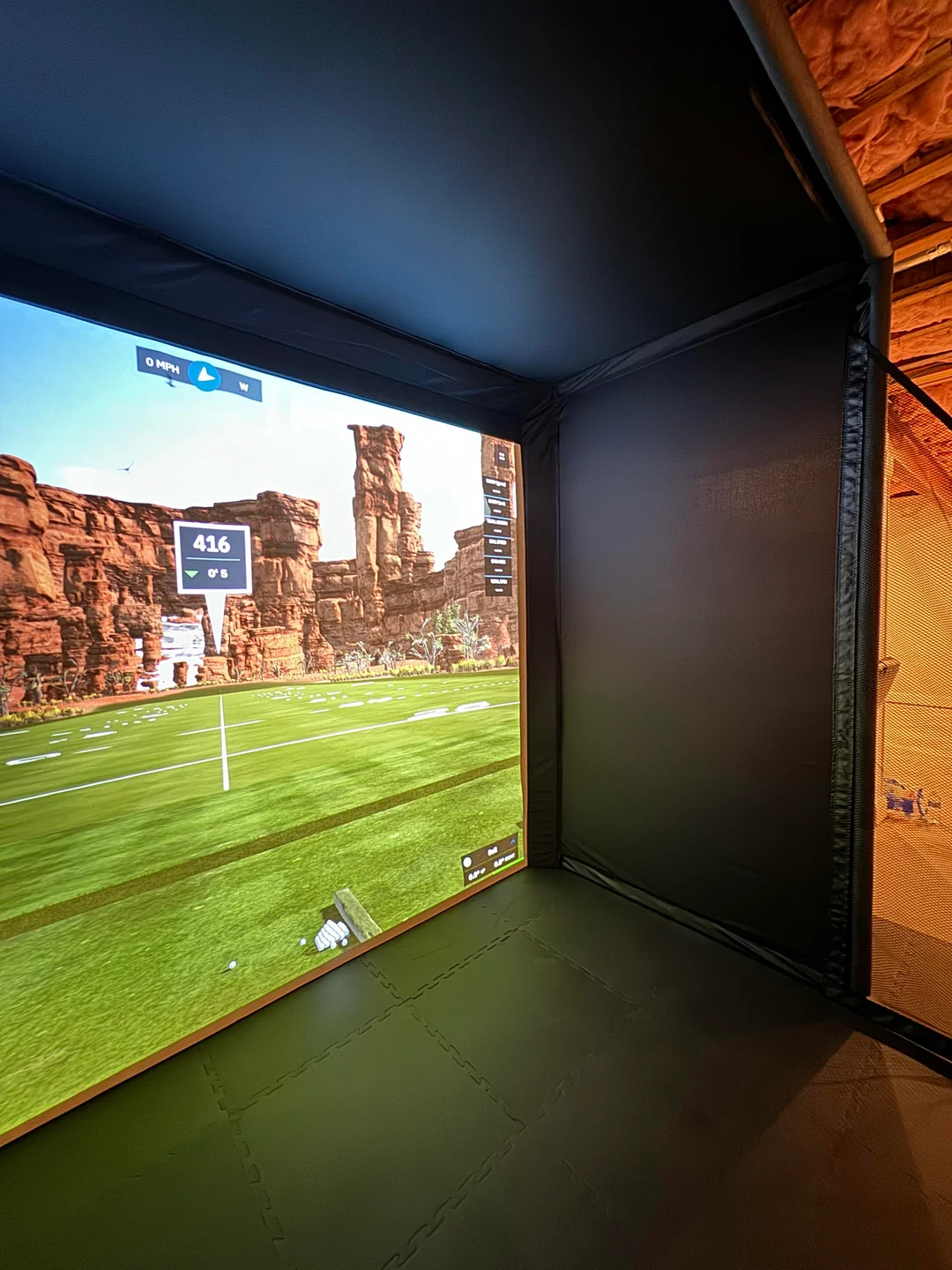
Carl’s Pro Enclosure is built for serious, dedicated simulator rooms. The frame is heavy 2-inch EMT, which produced zero rack or sway even on high-speed impacts, and Carl’s Place will size it to the inch to get the biggest screen your ceiling and room allow.
A cable tensioning system along the bottom of the screen keeps the canvas flat and wrinkle-free, which matters for a sharp projected image. The Premium screen option absorbs ambient light noticeably well.
Our take: The 2-inch pipe is heavy and awkward. Sourcing, transporting and maneuvering it took two people and multiple ladders. Because the frame is rigid steel, treat Carl’s precut foam inserts as mandatory so an errant shot can’t bounce hard off bare pipe.
Price: from $3,409.95 with impact screen at Carl’s Place (checked Sep 30, 2026).
Frame: 2-inch EMT (buy locally or add the Pipe Framing Kit). Sizing: standard or custom to the inch.
| Pros | Cons |
|---|---|
|
|
Carl’s Place DIY Enclosure Kit
This is the kit in Reid’s own garage, and the benchmark for cost-conscious home builds. Carl’s Place supplies the corner fittings, black fabric surround and impact screen; you buy standard 1-inch EMT at a home improvement store and cut it to length. Buying the pipe locally saves a lot on shipping, and it is easy to cut it down for a tight basement or an angled ceiling.
Reid put the frame together and wrapped the fabric around it in a little over an hour. The whole enclosure, with frame padding, took closer to two and a half hours because he took his time with the video instructions. It sits sideways in a three-car garage so a car still parks next to it every day. See the full garage build.
Our take: Ball bungees around the whole perimeter give you manual control over screen tension: looser for less bounceback, tighter for a flatter picture. The black outer sleeve feels more like a heavy tarp than the softer fabric on the higher-end kits, and the frame padding is a separate purchase, so budget for it.
Price: from $999.95 with impact screen at Carl’s Place (checked Sep 30, 2026).
Frame: 1-inch EMT (buy locally or add the Pipe Framing Kit). Sizing: standard or custom.
| Pros | Cons |
|---|---|
|
|
PlayBetter SimStudio
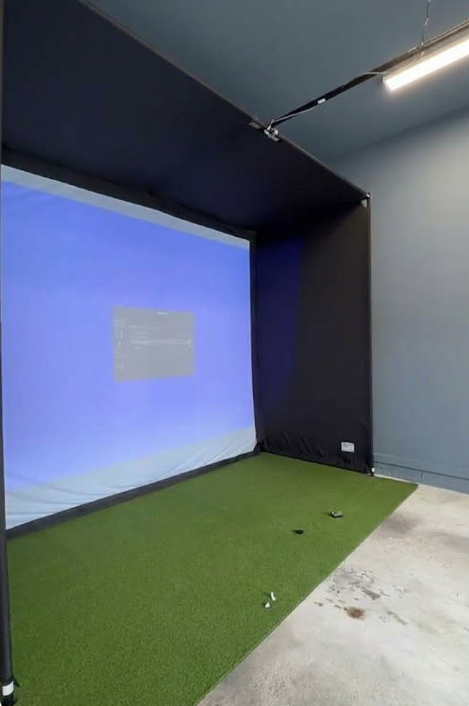
PlayBetter’s SimStudio line sits between budget DIY kits and expensive custom builds. The enclosure, impact screen, precut foam inserts and safety baffles arrive in one delivery, with no surprise add-ons, and the tool-free metal frame is realistic for one person to assemble.
Screen ramps to the floor turf and clip-in side baffle strips close the gaps where balls usually escape.
Our take: The bundled screen is a heavy-gauge polyester. It makes a bit more of a thump on impact than a woven fleece screen, but it has shown virtually no wear from ball strikes after thousands of shots. The corner brackets sit proud of the fabric, so place the internal safety pads carefully.
Price: $2,195 for the SimStudio BYO package at PlayBetter (checked Sep 30, 2026).
Sizes: SimStudio8, 10 (10′ W x 8’6″ H x 5’4″ D), 12 and 13 Deep. Frame: tool-free metal.
| Pros | Cons |
|---|---|
|
|
SportScreen Vanish Series
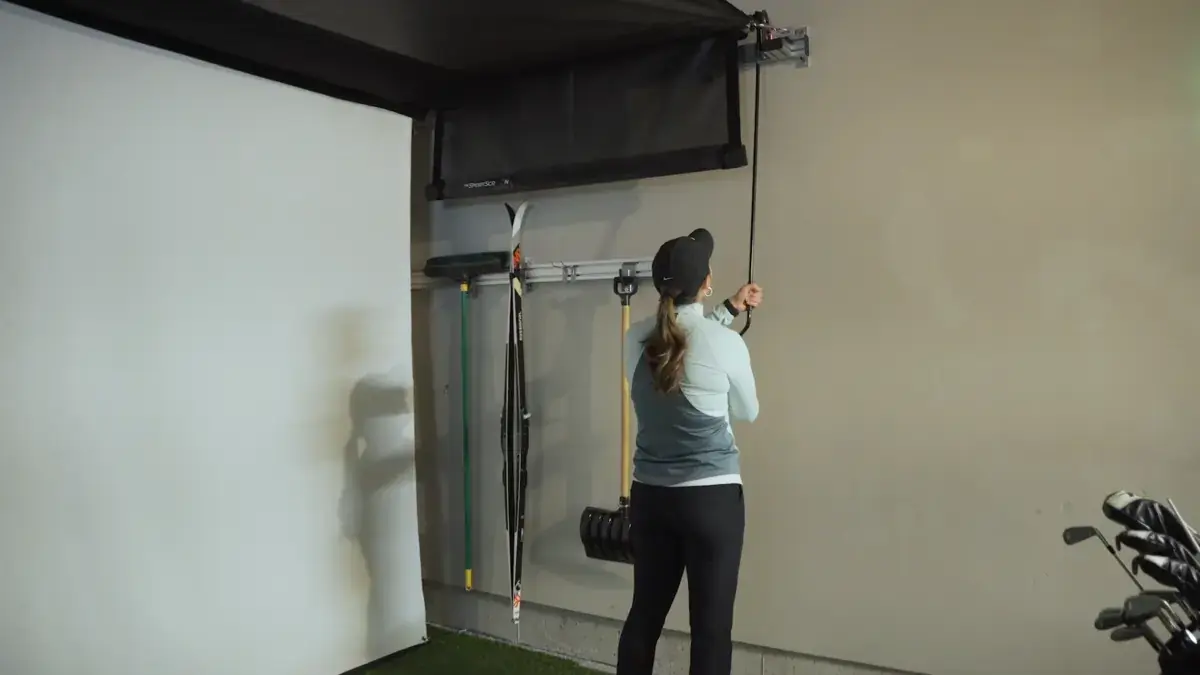
The Vanish is a premium retractable enclosure. The impact screen and side panels come down together by remote or hand crank and roll back up into a sleek aluminum header that hides the rollers, so a garage goes back to being a garage.
A heavy blackout layer hangs behind the impact screen. It deadens ball energy and stops light from bleeding through the back. If you only have one wall to mount to or a tight space, the lower-priced Vanish LITE swaps the retracting side panels for sliding side curtains that pin back.
Our take: The Vanish fixes the biggest weakness of a plain roll-up screen, which is containing a shank, without making you re-hook side baffles every time you put the simulator away. Mounting the header takes precision and solid anchor points, so plan the install carefully.
Price: $2,999.99 (Vanish 9, hand crank) to $5,499.99 (Vanish 16, remote) at The SportScreen (checked Sep 30, 2026).
Widths: 9, 11, 13 and 16 feet. Operation: hand crank or remote control.
| Pros | Cons |
|---|---|
|
|
G-Trak Retractable Screen
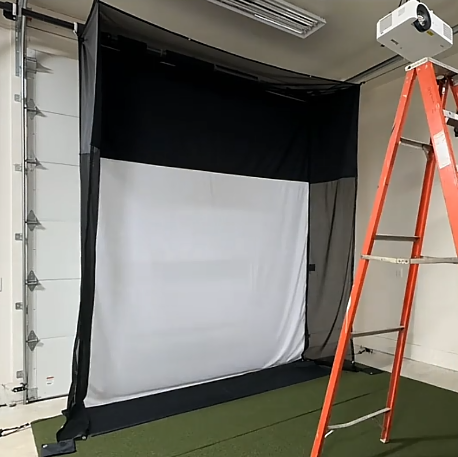
The G-Trak is engineered for garages. It mounts to your ceiling or your existing garage door tracks, using space around the door mechanism that is otherwise wasted, and fits garage doors between 8 and 16 feet wide. It drops down when you play and rolls up when you park, leaving nothing on the floor.
Our take: It doesn’t have the enclosed, sound-dampening feel of a fixed enclosure, but it is one of the few setups that takes you from full driver practice back to parking two cars in under three minutes. Like other roll-up screens, it can develop slight edge curl or horizontal waves over time.
Price: see the current price at G-Trak.
Mounting: garage door tracks or ceiling. Fits doors 8 to 16 feet wide.
| Pros | Cons |
|---|---|
|
|
Best golf simulator impact screens
The frame is the skeleton; the impact screen takes the beating. A good screen lets the ball stretch into the fabric, soaks up its energy and drops it straight down instead of firing it back at you. It also has to give you a sharp, bright image.
Most of the enclosures above come with a screen: the SIG uses a dual-layer screen, the Vanish a 3-ply screen with a blackout layer, and the PlayBetter a heavy-gauge polyester screen. If you are building your own or replacing a worn screen, both Carl’s Place and Shop Indoor Golf sell screens on their own, cut to size.
Room lighting should drive the color choice. Shop Indoor Golf’s SIGPRO Premium is a white, three-layer spacer-mesh screen built to be quiet, durable and low on bounceback, and it suits darker rooms. The SIGPRO Premier uses the same three-layer material in gray, which absorbs some ambient light and keeps the image from washing out in a brighter room. The SIG Preferred is a single-layer, reinforced screen that costs less and works well for home use, but Shop Indoor Golf does not recommend it for commercial settings.
| Screen | Best for | Price |
|---|---|---|
| SIG Preferred Finished Impact Screen | Budget home builds (single layer, residential use only) | From $251.59 |
| SIGPRO Premium Impact Screen | Quiet, durable three-layer screen for darker rooms | From $419.99 |
| SIGPRO Premier Impact Screen (Gray) | Brighter rooms where you want more contrast | From $689.99 |
| Carl’s Standard Impact Screen | Budget builds with 10+ feet of ball-to-screen distance | From $179.95 |
| Carl’s Preferred Impact Screen (Smooth HD) | Most home sims | From $298.95 |
| Carl’s Premium Impact Screen | Rooms with ambient light, closer hitting distances | From $439.95 |
| Carl’s High-Contrast Gray Impact Screen | Brighter rooms where you want more contrast | From $449.95 |
Single-layer or looser-weave screens can still be safe if you keep at least 10 to 12 feet between the ball and the screen, give the screen some slack with bungees and leave air space behind it. If a garage forces you closer, around 8 to 9 feet, go with a premium multi-layer screen, which is more forgiving. For the details, see our guides to screen materials, reducing bounceback and hanging an impact screen.
How to choose a golf simulator enclosure
Measure the room first
The first decision is space, not brand. A fixed enclosure needs enough depth for the ball to hit the screen, slow down and drop before it can rebound; about 5 feet of enclosure depth is the usual standard. Leave working room around the frame too: Carl’s Place, for example, asks for at least 2 inches above the Pro enclosure, 2 to 3 inches on each side and 12 inches behind it. Our room size guide and enclosure depth guide walk through the numbers.
Fixed, retractable or DIY
Fixed enclosures (SIG, Carl’s Pro, PlayBetter) give the most protection, the best acoustics and the cleanest image. Retractable systems (SportScreen Vanish, G-Trak) give the space back when you are done. DIY pipe kits (Carl’s Place DIY) cost the least and fit odd rooms, in exchange for a trip to the hardware store and some pipe cutting. Our DIY enclosure plans cover the build.
Protect the frame and the room
Side walls and a ceiling panel are not cosmetic: they are shank protection and light control in one. On any bare steel frame, add foam padding so a mishit can’t bounce hard off the pipe. See our guide to simulator padding for walls and ceilings.
Plan around your launch monitor
Overhead launch monitors need a mounting point at the right depth. Carl’s Pro supports mounting to the front bar or an optional crossbar. Side-sitting units need extra room width instead.
Golf simulator enclosure FAQs
What is the best golf simulator enclosure for home use?
For most homes, the SIG10 from Shop Indoor Golf: it fits a standard 10-foot space, goes together without tools and handles bounceback well out of the box. For a dedicated room built to fit, choose the Carl’s Place Pro. On a tight budget, the Carl’s Place DIY kit. For a garage you still park in, the SportScreen Vanish or the G-Trak.
How much space do I need for a golf simulator enclosure?
At a minimum, a room about 10 feet wide, 12 feet deep and 9 feet high, though 12 to 14 feet of width and a 10-foot ceiling make a driver swing more comfortable. Most fixed enclosures want about 5 feet of depth to absorb the ball safely. Our room size guide goes into detail.
What is included in a golf simulator enclosure kit?
Usually a frame (push-pin steel or 1-inch or 2-inch EMT pipe that you buy locally), an impact screen, black fabric side walls and a ceiling panel. Better kits add foam frame padding, ball bungees for tensioning the screen, safety baffles and net extensions for extra shank protection.
Can I install a golf simulator enclosure outdoors?
Only one designed for it, with UV-resistant fabric, rust-proof framing and a screen that won’t move in the wind. Most people use a retractable screen or a portable net outdoors unless they have a covered patio or an outbuilding.
How does a retractable golf simulator enclosure work?
The impact screen, and on some models the side panels, roll up into a ceiling- or wall-mounted header by remote or hand crank. The SportScreen Vanish retracts the whole enclosure; the G-Trak mounts on your garage door tracks and leaves nothing on the floor. See our guide to retractable golf screens.
For most home builds, get the SIG10: it fits a standard room, snaps together and controls bounceback well. Step up to the SIG Professional or the Carl’s Place Pro for a dedicated room, or save with the Carl’s Place DIY kit if you don’t mind cutting pipe. PlayBetter’s SimStudio is the easiest all-in-one box.
If the space has to stay a garage, the SportScreen Vanish is the best retractable full enclosure and the G-Trak is the fastest way back to parking. Building your own frame or replacing a worn screen? Pick the SIGPRO Premium for a dark room, the SIGPRO Premier for a bright one, or the SIG Preferred if you want to keep the cost down.
Reid has played golf for more than 40 years and plays to a 5 handicap. He built his own garage simulator around a Carl’s Place DIY enclosure and applies a data-driven, structured testing approach to every simulator product he reviews.



One Comment